BRRRR STRATEGY
What Is the BRRRR Strategy?
The BRRRR strategy is a real estate investing method designed to help you acquire, improve, stabilize, and retain rental properties while recovering some or all of the capital invested in each project.
BRRRR in simple terms
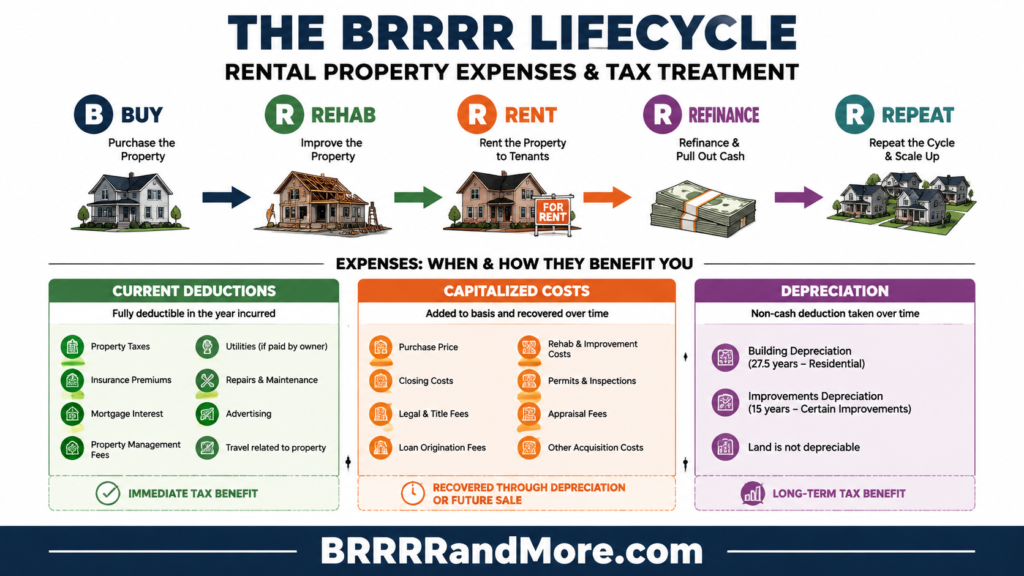
BRRRR stands for Buy, Rehab, Rent, Refinance, Repeat. You purchase a property with improvement potential, complete the necessary rehabilitation, rent it, refinance it using long-term financing, and then decide whether you’re financially and operationally ready to repeat the process.
The strategy is best understood as a capital-recycling framework—not a guarantee that every project will return every dollar you invested.
The BRRRR Method at a Glance
The five stages are connected. Your purchase price affects the renovation budget. The renovation affects achievable rent and appraised value. Rent and operating expenses affect the property’s ability to support long-term debt. The refinance determines how much capital remains tied up in the property.
- 1 Buy Acquire the property at a total basis that supports the complete plan.
- 2 Rehab Correct deficiencies and make improvements that support rent, value, and durability.
- 3 Rent Place the property into service with sustainable rent and competent management.
- 4 Refinance Replace short-term capital with financing suited to the stabilized rental.
- 5 Repeat Redeploy capital only after the first property is financially and operationally stable.
| Stage | Primary objective | Central question |
|---|---|---|
| Buy | Acquire at a defensible basis | Is the purchase price low enough to support the entire plan? |
| Rehab | Create usable and financeable value | Will the improvements support rent, appraisal value, and durability? |
| Rent | Stabilize the property as a rental | Will the property attract qualified tenants and produce sustainable income? |
| Refinance | Replace short-term capital | Will the property qualify for sufficient financing without weakening cash flow? |
| Repeat | Redeploy capital responsibly | Is your first property stable enough to support another acquisition? |
What Does BRRRR Mean?
Buy
Your first objective is to purchase a property with enough potential value to justify the cost and risk of the project. BRRRR investors often target properties that need repairs, suffer from deferred maintenance, are poorly managed, or are unattractive to buyers seeking a finished home.
Potential sources include foreclosures, pre-foreclosures, bank-owned properties, estate sales, tired landlords, wholesalers, auctions, direct-to-seller marketing, and ordinary Multiple Listing Service listings. A distressed property, however, is not automatically a good BRRRR property.
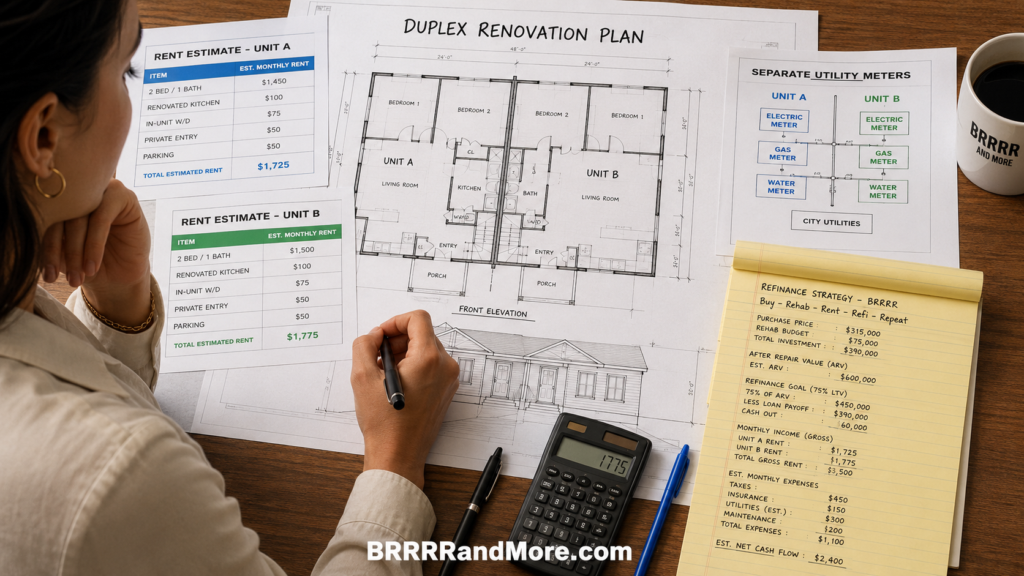
Before you make an offer, estimate the purchase price, acquisition costs, complete rehabilitation budget, financing expenses, holding costs, project timeline, after-repair value, achievable rent, operating expenses, likely refinance terms, and capital that may remain in the deal.
This is a framework, not an automatic offer formula. A screening rule such as the 70 percent rule can help you eliminate obviously unsuitable properties, but it doesn’t replace property-specific underwriting.
Rehab
Your rehabilitation should do more than make the property look better. It should correct material deficiencies, make the property durable and competitive as a rental, and complete improvements that are reasonably supported by local rent and resale comparables.
Correct deficiencies
Address structural, mechanical, moisture, safety, code, and habitability issues before cosmetic upgrades.
Build for rental use
Choose durable materials and practical finishes that fit tenant expectations and operating needs.
Support the value
Complete improvements that comparable rents and sales can reasonably justify.
The most expensive renovation is not necessarily the best renovation. If you overimprove the property, you may consume capital without receiving a proportional increase in rent or appraised value.
Before closing, document the scope in enough detail to determine what work is required, what it should cost, how long it may take, and how you’ll respond if the estimate is wrong. Written scopes, multiple contractor bids, permit research, and contingency reserves are basic risk controls.
Watch the timeline: Every additional month can add interest, taxes, insurance, utilities, lawn care, security, and other expenses without producing rental income. A project that works on paper can become marginal when the rehab takes materially longer than planned.
Rent
Once the rehabilitation is complete, the property must operate as a rental business. Stabilization involves more than placing a tenant. You’ll need to establish a realistic rent, attract qualified applicants, comply with applicable rental requirements, execute an appropriate lease, collect deposits and initial payments, and create a system for ongoing management.
Base your rent estimate on sustainable market evidence rather than the highest advertised rent you can find. Consider recently leased comparables, property type and condition, included utilities, parking and amenities, seasonal leasing conditions, vacancy, tenant demand, and any rental registration or inspection requirements.
Your operating analysis must include more than the mortgage payment. Allow for taxes, insurance, vacancy, repairs, capital expenditures, property management, owner-paid utilities, association fees, licensing, turnover, and other property-specific costs.
Underwrite management even if you plan to self-manage. Your time has value, and you may eventually need professional management. A deal that works only because you assign no cost to management is less durable than it appears.
Refinance
The refinance is the financial hinge of the BRRRR strategy. You replace the acquisition or construction financing with a longer-term loan suited to the stabilized rental. The new loan may pay off hard money, private money, bridge financing, a line of credit, or other short-term capital.
The amount available isn’t determined by appraised value alone. Depending on the lender and loan program, approval may be affected by loan-to-value limits, rent, debt service coverage ratio, credit, income, reserves, property condition, title history, seasoning requirements, lease documentation, property type, and insurance availability.
You should investigate the likely refinance before you purchase the property—not after the renovation is complete. You should also evaluate the refinance as a new investment decision. Taking the largest available loan may recover more capital, but it can reduce cash flow and leave less room for future expense increases.
Repeat
Repeating means using the experience, systems, and recovered capital from one stabilized property to pursue another opportunity. It doesn’t mean purchasing the next property immediately after the refinance closes.
Before you expand, review actual rent collections, repairs, vacancy exposure, insurance, reserves, debt service, and management workload. Refinance proceeds aren’t automatically profit. You still own the property, remain responsible for the debt, and may need the recovered funds for reserves or future capital expenditures.
How the BRRRR Strategy Creates Value
BRRRR is sometimes described as a way to acquire rentals with little or no money left in each deal. That outcome is possible, but it is not the underlying source of value. The strategy depends on creating a meaningful difference between your total project basis and the property’s stabilized value.
Buy below stabilized potential
You may find a discount because the property needs repairs, cannot qualify for conventional financing, has poor management, or is being sold under time pressure.
Create value through rehabilitation
You convert an underperforming property into a safe, functional, financeable, and rentable asset. The market—not the amount you spend—determines how much value was created.
Produce rental income
Your operating return comes from collected rent after vacancy, operating expenses, reserves, and debt service—not from gross scheduled rent alone.
Recover capital through refinancing
If the stabilized property supports a sufficient loan, you may recover some or all of the capital used for acquisition and renovation.
You also retain a long-term asset rather than selling immediately after the renovation. Over time, the property may benefit from loan amortization, changes in rent, and changes in market value. You shouldn’t rely on future appreciation to rescue a weak initial deal.
BRRRR Method Example With Real Numbers
This hypothetical example shows how a BRRRR project might work. It includes the financing payoff and refinance expenses that simplified examples often omit.
Initial project budget
| Item | Amount |
|---|---|
| Purchase price | $145,000 |
| Rehabilitation | $40,000 |
| Acquisition, financing, and holding costs | $15,000 |
| Total project cost | $200,000 |
Assume you use a combination of short-term financing and personal capital:
| Capital source | Amount |
|---|---|
| Short-term acquisition and rehab loan | $130,000 |
| Your capital | $70,000 |
| Total capital | $200,000 |
After the renovation, comparable sales support an after-repair value of $250,000, and the property is leased for $2,200 per month.
Refinance estimate
Assume a lender approves a new loan equal to 70 percent of the appraised value:
The new loan is not the amount returned to you. The existing loan, refinance costs, escrows, and reserves must be paid first.
You originally contributed $70,000 and receive approximately $40,000 after the refinance.
You did not recover all of your original capital. That doesn’t necessarily make the project unsuccessful. At an appraised value of $250,000 with a $175,000 loan, you have approximately $75,000 in gross property equity before selling costs or changes in market value.
Simplified rental operations
| Item | Monthly amount |
|---|---|
| Gross scheduled rent | $2,200 |
| Vacancy and credit allowance | − $110 |
| Taxes and insurance | − $350 |
| Repairs and capital reserves | − $220 |
| Property management allowance | − $176 |
| Estimated net operating income | $1,344 |
If the new loan has monthly debt service of $1,120, the simplified projected cash flow is:
The simplified debt service coverage ratio is:
Keep the financial results separate: In this example, you recover $40,000, leave $30,000 of your original capital in the property, retain approximately $75,000 in gross equity, and project $224 per month in cash flow. Equity is not available cash, refinance proceeds are not profit, and positive cash flow doesn’t eliminate the need for reserves.
Why BRRRR Deals Are Sensitive to the Appraisal
The previous example assumes the property appraises for $250,000. A lower appraisal would reduce the refinance proceeds and leave more of your capital in the property.
| Appraised value | Gross refinance loan | Cash returned* | Capital left in deal |
|---|---|---|---|
| $250,000 | $175,000 | $40,000 | $30,000 |
| $235,000 | $164,500 | $29,500 | $40,500 |
| $220,000 | $154,000 | $19,000 | $51,000 |
*Assumes a 70% loan-to-value ratio, a $130,000 existing loan payoff, and $5,000 in refinance costs and escrows.
A $30,000 difference in appraised value reduces the estimated cash returned by $21,000 in this example. Your property should remain financially supportable if the appraisal is lower than projected. If you must recover every dollar to avoid a cash shortage, the deal has little margin for error.
How to Analyze a BRRRR Deal Before You Buy
A thorough BRRRR analysis works backward from the stabilized property. You begin with the likely value, rent, expenses, financing, and exit options, then determine the purchase price the project can support.
1. Establish a conservative after-repair value
Review comparable properties that are similar in location, size, age, design, condition, and property type. Avoid relying primarily on active listings because asking prices do not establish completed market transactions.
2. Estimate market rent
Use recently leased comparable properties when available. Adjust for differences in condition, utilities, parking, amenities, bedroom count, and location. Prepare a downside scenario using lower rent or a longer lease-up period.
3. Build a complete rehabilitation scope
Separate known repairs from allowances and unknown conditions. Include permits, demolition, debris disposal, material delivery, security, utility work, cleaning, landscaping, and final punch-list items.
4. Calculate your total project basis
Include acquisition closing costs, loan points and fees, interest, taxes, insurance, utilities, permits, legal and title costs, appraisal fees, project-management expenses when material, and contingency reserves.
5. Estimate stabilized operating expenses
Calculate expected net operating income using realistic vacancy, maintenance, capital expenditure, management, tax, insurance, and utility assumptions. Determine whether taxes or insurance may change after the purchase or renovation.
6. Model the refinance before making an offer
Contact potential lenders and model several combinations of appraised value, loan-to-value ratio, interest rate, amortization, debt service coverage, seasoning, closing costs, reserves, and occupancy documentation.
7. Calculate capital left in the deal
A deal can still be attractive with capital remaining in it. The question is whether the equity, cash flow, risk, and long-term prospects justify your remaining investment.
8. Stress-test the project
Test the result under a lower appraisal, rehab overrun, longer timeline, lower rent, higher expenses, increased refinance costs, smaller refinance loan, extended vacancy, and unexpected major repair.
9. Prepare more than one exit strategy
Your alternatives may include holding without immediately refinancing, accepting less cash back, bringing additional capital to closing, selling after rehabilitation, using different long-term financing, extending the short-term loan, or partnering with another investor.
A deal that works only under the original assumptions isn’t conservatively underwritten. You don’t need to predict every possible problem, but you should understand which assumptions have the greatest effect on the outcome.
Where BRRRR Investors Make Mistakes
Paying too much
A good renovation cannot always correct a bad purchase price. An excessive basis leaves little room for a low appraisal, construction overrun, or financing change.
Treating ARV as a goal
Your after-repair value must be supported by market evidence. It isn’t determined by the amount you want to borrow or recover.
Underestimating the rehab
Electrical, plumbing, foundation, moisture, sewer, mechanical, and unpermitted-work problems can materially change the budget.
Ignoring holding costs
Interest, taxes, insurance, utilities, security, and maintenance continue while the property produces no rent.
Overimproving the property
Personal design preferences may increase cost without producing a proportional increase in rent or appraised value.
Planning the refinance too late
Seasoning, documentation, reserves, coverage, or property-condition requirements can delay or reduce the loan.
Assuming full capital recovery
The appraisal, loan limits, payoff, closing costs, rent, and debt service all affect how much cash you receive.
Overestimating rent
An overpriced rental may remain vacant or require concessions. Use realistic leased comparables and local demand.
Underestimating expenses
Taxes, insurance, repairs, vacancy, turnover, reserves, utilities, and management can consume a substantial share of rent.
Repeating too soon
Multiple rehabs, loan maturities, vacancies, and repair obligations can create a liquidity problem even when each property appears profitable.
When the BRRRR Strategy Works Best
BRRRR may fit when:
- You can acquire the property below its stabilized potential.
- The rehabilitation scope is understandable and reasonably controllable.
- The rental market supports the completed property.
- The likely refinance is supported by lender feedback and conservative assumptions.
- You have adequate liquidity and contingency reserves.
- You can coordinate the acquisition, rehab, leasing, financing, and management stages.
- You can continue holding the property if the refinance returns less cash than expected.
BRRRR may not fit when:
- The property is already priced near its stabilized value.
- Rent is too low relative to the total project cost.
- The rehabilitation contains major unquantifiable risk.
- The plan depends on a perfect appraisal.
- Short-term financing expires before a realistic exit.
- Insurance, taxes, or operating expenses make the rental unsustainable.
- You have no reserve capital or management capacity.
- Another strategy better fits the property and your objectives.
The acronym should not determine your strategy. The property, financing, market, and your own financial capacity should determine whether you pursue the deal.
How BRRRR Compares With Other Strategies
BRRRR vs. traditional buy and hold
A traditional buy-and-hold investor may purchase a rent-ready property, place long-term financing at acquisition, and retain the property without a major renovation or near-term refinance. With BRRRR, you accept more acquisition and construction complexity in an attempt to create equity and recover capital.
| Consideration | BRRRR | Traditional buy and hold |
|---|---|---|
| Initial property condition | Often distressed or underperforming | Often rent-ready or nearly rent-ready |
| Renovation requirement | Usually material | Often limited |
| Initial financing | May use cash, hard money, private money, or bridge financing | Often uses long-term financing at purchase |
| Operational complexity | Higher during acquisition and rehab | Generally lower |
| Refinance | Central to the strategy | Optional |
| Capital recycling | A primary objective | Usually not an immediate objective |
BRRRR vs. fix and flip
BRRRR and fix-and-flip investors may target similar distressed properties and perform similar renovations. The intended exit is different. A flipper normally sells after the renovation. With BRRRR, you lease the property, refinance it, and continue owning it.
A property that works as a flip may not work as a rental. A property with strong rental economics may not provide enough resale margin for a flip. Compare the expected sale price, selling expenses, market time, achievable rent, operating costs, long-term financing, liquidity, taxes, and management requirements.
Does the BRRRR method still work?
The method isn’t dependent on a particular year. Its viability depends on the relationship among total project cost, stabilized value, sustainable rent, operating expenses, and available financing.
When property prices, interest rates, insurance, construction costs, rents, or lender requirements change, you must adjust your purchase criteria, financing assumptions, reserves, and return expectations. You shouldn’t force old assumptions onto a changed market.
Questions to Answer Before You Start a BRRRR Project
Before you purchase, you should be able to answer the following questions or clearly identify how you’ll resolve the remaining uncertainty.
- What conservative after-repair value is supported by comparable sales?
- What is the complete rehabilitation scope?
- Which costs are fixed, estimated, or still unknown?
- How much contingency and reserve capital is available?
- What is the realistic renovation and lease-up timeline?
- What rent is supported by comparable leased properties?
- What are the stabilized operating expenses?
- Which lender or loan type is likely to fund the refinance?
- What seasoning, appraisal, reserve, occupancy, and documentation requirements may apply?
- How much cash will be returned under your base case?
- How much capital will remain if the appraisal or loan amount is lower?
- Will the property still produce acceptable cash flow after refinancing?
- Can you hold the property if the refinance is delayed?
- What secondary exit strategies are realistically available?
- How will you manage the property after it is rented?
Frequently Asked Questions
Does a BRRRR deal have to return all of your money?
No. Recovering all invested capital is sometimes presented as the ideal outcome, but a deal can still be successful with capital remaining in the property. Evaluate the equity, cash flow, leverage, risk, and expected return on the capital that remains.
Can a beginner use the BRRRR strategy?
Yes, but the strategy combines acquisition, construction, financing, leasing, and property management. You should compensate for limited experience with conservative assumptions, qualified inspections, detailed scopes, lender discussions, adequate reserves, and experienced professional support.
Do you need to pay cash for a BRRRR property?
No. You may use cash, hard money, private money, bridge financing, lines of credit, partnerships, or a combination of funding sources. The financing structure affects required cash, carrying costs, loan payoff, refinance proceeds, and risk.
Is BRRRR passive income?
Not during acquisition, rehabilitation, and refinancing. The completed rental may become less management-intensive, particularly if you hire professional management, but ownership remains an operating and financial responsibility.
What happens if the appraisal is too low?
A low appraisal may reduce the loan amount and leave more of your capital in the property. Depending on the situation, you may accept a smaller refinance, bring additional cash, correct material appraisal errors, use another loan program, wait and refinance later, continue holding, or sell.
How long does a BRRRR project take?
The timeline depends on property condition, permits, contractor availability, renovation scope, inspections, lease-up, lender requirements, seasoning, and refinance processing. Model schedule contingencies rather than assuming every stage will occur without delay.
Can BRRRR work with small multifamily properties?
Yes. You can apply the framework to single-family rentals, duplexes, triplexes, four-unit properties, and larger multifamily assets. Valuation, financing, management, and operating analysis may differ by property type.
Is a high after-repair value enough to make a good deal?
No. A property can have substantial equity and still produce weak cash flow, require excessive capital, or carry unacceptable construction and financing risk. Evaluate value, income, expenses, debt, liquidity, and execution risk together.
BRRRR Calculators and Related Resources
Use these permanent site resources to evaluate individual stages of the process. Replace the placeholder URLs when each destination is published.
BRRRR Calculator
Estimate project cost, refinance proceeds, capital left in the deal, cash flow, cash-on-cash return, loan-to-value ratio, and debt service coverage.
Use the BRRRR CalculatorDeal Analysis Hub
Review after-repair value, rent analysis, operating expenses, financing assumptions, exit strategies, and common red flags.
Explore Deal AnalysisFind BRRRR Deals
Explore foreclosures, pre-foreclosures, tired landlords, auctions, wholesalers, and off-market acquisition channels.
Find BRRRR DealsRehab Budgeting Hub
Estimate repairs, prepare scopes, compare contractor bids, calculate holding costs, and plan contingencies.
Plan the RehabilitationBRRRR Financing Hub
Compare hard money, private money, bridge loans, DSCR loans, and other financing structures.
Review Financing OptionsRefinance Strategy
Examine LTV, appraisal risk, seasoning, DSCR, refinance proceeds, capital recovery, and fallback options.
Plan the RefinanceProperty Management Hub
Review tenant screening, rent collection, maintenance, turnover, lease enforcement, and management decisions.
Manage the RentalFinal Perspective
The BRRRR strategy is best understood as a coordinated investment process rather than a formula for acquiring unlimited properties without using money.
Its potential advantage is capital efficiency. By purchasing below stabilized potential, improving the property, creating rental income, and refinancing responsibly, you may retain a long-term asset while recovering capital for other uses.
Its risks are also interconnected. A high purchase price, incomplete rehab budget, weak rent estimate, low appraisal, expensive refinance, or poorly managed rental can affect every stage that follows.
The most durable BRRRR projects aren’t necessarily the ones that return every dollar as quickly as possible. They’re the ones that remain stable under realistic assumptions, maintain adequate reserves, produce sustainable rental income, and give you more than one workable exit.
Buy carefully. Rehab with a defined purpose. Rent based on sustainable operations. Refinance without overleveraging. Repeat only when your existing portfolio is ready.
This page is for general educational purposes and does not provide legal, tax, lending, appraisal, construction, or investment advice. Loan requirements, property laws, costs, and market conditions vary. Verify material assumptions with qualified local professionals before making an investment decision.