Fed Money Printing and Real Estate When Liquidity Returns
The Fed has already cut rates by 75 basis points. Mortgage rates are higher now than they were at their late-February low. Treasury has announced larger buybacks of long-dated government bonds, while Washington is widening economic pressure on Iran and inflation risk remains unresolved.
That combination should change how real estate investors think about the next easing cycle.
The important question is not whether the Fed can cut another quarter point. It is what happens if ordinary rate cuts fail, long-term borrowing costs stay painful, and policymakers eventually reach for a much larger balance-sheet response.
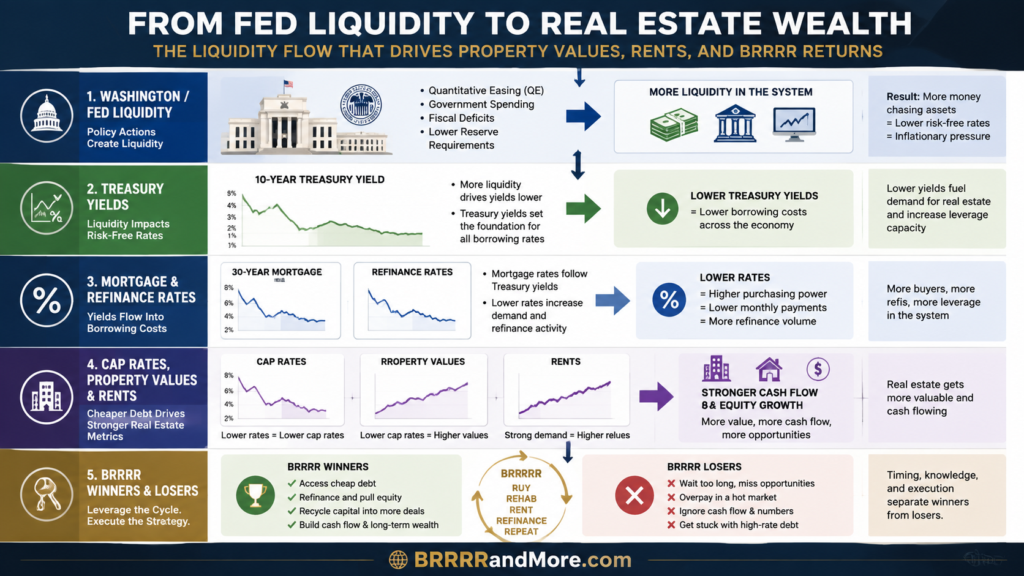
For BRRRR investors, landlords, and developers, Fed money printing and real estate is not a simple “more dollars means higher property prices” story. Its outcome depends on why the liquidity arrives, whether long-term yields actually fall, and how much leverage sits on the property when the policy shift begins.
The First Warning Is That Rate Cuts Did Not Deliver Cheap Mortgages
The Federal Reserve lowered the federal-funds target three times in late 2025, taking the range from 4.25%–4.50% to 3.50%–3.75%. It has held that range through 2026. In July, three FOMC voters actually preferred a quarter-point increase because inflation remained above target and energy-related supply shocks were still feeding price pressure. The Fed’s July 2026 policy statement makes that split unusually clear.
Housing finance did not follow the hoped-for path.
Freddie Mac’s 30-year fixed mortgage average reached 5.98% on February 26, then climbed back to 6.65% by August 20. The Freddie Mac mortgage-rate archive shows how quickly the early-2026 relief disappeared.
That move is the practical lesson for property investors. The Fed controls an overnight policy rate, not a 30-year mortgage rate. Long-term Treasury yields, inflation expectations, mortgage-backed-security spreads, credit risk, and investor demand all sit between a Fed announcement and the refinance quote you receive.
A BRRRR deal that requires “the Fed to cut” can therefore fail even when the Fed does exactly that.
Washington Is Already Pushing Against the Long End
Recent bond-market action adds another layer.
Treasury Secretary Scott Bessent announced that Treasury would double the size of planned buybacks in 10- to 30-year securities, with the enlarged program scheduled to begin September 10. The announcement helped pull yields lower initially, but it did not erase the deeper problem of expensive long-term government borrowing. Reuters reporting on the expanded Treasury buybacks also noted that Bessent warned countries about continued business ties with Iran as Washington intensified economic pressure.
That episode needs one factual correction because the distinction affects the thesis.
The recent long-bond intervention was a Treasury action, not a new Federal Reserve QE program.
Treasury buybacks can improve liquidity and alter the mix of government debt outstanding, but Treasury cannot create bank reserves the way the Fed can. A genuine “print big” event would involve the central bank expanding its balance sheet on a scale intended to change financial conditions, not simply managing the government’s debt profile.
The fact that Treasury is already uncomfortable enough with long yields to enlarge buybacks is still significant. Real estate financing is tied to the same long-duration market that determines how much Washington pays to borrow.
The Iran Shock Makes Easy Money Harder to Deliver
Economic sanctions on Iran add pressure from a different direction.
Energy markets sit directly in the transmission path from geopolitics to inflation. Restrictions on Iranian trade, shipping, finance, and oil can raise uncertainty even when crude prices fall on a particular day. Higher energy costs feed transportation, construction materials, utilities, household budgets, and inflation expectations.
That creates an awkward policy mix.
Washington wants lower long-term borrowing costs because housing, government debt service, construction, and business investment all suffer when yields stay elevated. The Fed, however, cannot ignore renewed inflation simply because mortgages are expensive.
A central bank facing weak housing and stubborn inflation has fewer clean choices than one fighting a normal recession.
If long-term yields remain high because investors demand compensation for inflation, deficits, or currency risk, another 25-basis-point cut may accomplish very little. Policymakers would then face growing pressure to influence the bond market more directly.
That is where the “when, not if” argument becomes plausible.
What “Print Big” Would Mean This Time
The phrase “printing money” is useful shorthand, but investors should separate several very different operations.
Since late 2025, the Fed has purchased shorter-term Treasury securities as part of maintaining ample reserves in the banking system. Those reserve-management purchases are not the same as quantitative easing.
A large-scale easing program would look different.
It could involve substantial purchases of longer-term Treasuries, mortgage-backed securities, or both. Emergency lending facilities might expand during a credit event. Repo operations could grow sharply if funding markets seize up. Policymakers could also use forward guidance or maturity-focused purchases to push harder on longer-term borrowing costs.
Size and intent are the key variables.
Short Treasury-bill purchases used to keep the banking system supplied with reserves are plumbing. Hundreds of billions of dollars in long-duration purchases designed to suppress borrowing costs would be monetary stimulus.
Real estate will react very differently to the second event.
There Are Three Ways Big Liquidity Could Hit Real Estate
The easiest mistake is assuming that every form of QE produces the same property cycle.
For investors analyzing Fed money printing and real estate, the cause of the liquidity is as important as the size of the program.
It does not produce one automatic outcome.
Scenario One — Inflation Breaks and the Fed Can Ease Cleanly
This is the outcome most property investors would prefer.
Suppose inflation falls convincingly, unemployment rises, economic activity weakens, and the Fed responds with aggressive asset purchases. Long-term Treasury yields decline because investors believe inflation is under control and the central bank is adding liquidity.
Mortgage rates would have a better chance of following Treasury yields lower. DSCR loan pricing could improve. Commercial debt could reprice downward. Buyers who were previously constrained by debt service would regain purchasing power.
Cap rates could compress as financing becomes cheaper and competing bond yields fall.
For BRRRR investors, the refinance step becomes easier. A stabilized property that barely misses a lender’s DSCR requirement at a 7% rate may work at 5.75%. Lower debt service can also improve monthly cash flow and reduce the amount of capital trapped in the deal.
Under this version of “print big,” property values probably receive broad support.
Scenario Two — The Fed Prints Into Inflation and Long Rates Stay Stubborn
This is the more difficult outcome and the one investors should not dismiss.
Imagine federal deficits remain large, Treasury issuance stays heavy, energy risk persists, and inflation refuses to return cleanly to target. Bond-market stress eventually becomes severe enough that the Fed expands its balance sheet anyway.
More liquidity would enter the system, but long-term yields might not collapse.
Investors could demand higher compensation for inflation or currency debasement even as the central bank buys bonds. Mortgage rates might fall somewhat without returning to the ultra-low levels many buyers still expect.
Real estate would split into winners and losers.
Properties with durable rents and long-term fixed-rate debt could become increasingly valuable. Replacement costs would likely rise as labor, materials, energy, and land become more expensive. Existing owners would repay old nominal debt with dollars that buy less.
New buyers would face a harder equation. Purchase prices could rise in nominal terms while financing remains costly enough to suppress cash flow.
That environment rewards good basis and existing fixed debt more than aggressive leverage.
Scenario Three — A Credit Event Forces Printing After Property Prices Fall
A large monetary response may arrive because something broke.
Treasury-market dysfunction, bank stress, recession, rising defaults, or another credit shock could force emergency liquidity before inflation has fully disappeared.
Real estate could decline first.
Rents may soften, vacancies can rise, lenders may tighten, and buyers can lose access to financing even while the Fed begins expanding its balance sheet. Distressed owners often have to sell before easier money reaches the property market.
That sequence would create a very different opportunity.
Investors with cash, financing relationships, and patience could acquire properties at weaker prices while policy support is building underneath the financial system.
The lesson is simple: a larger Fed balance sheet does not guarantee an immediate real estate rally.
Fixed-Rate Debt Could Be the Best Inflation Hedge Inside the Property
When investors call real estate an inflation hedge, they usually focus on rents and property values.
Debt deserves equal attention.
A $250,000 fixed-rate mortgage does not rise with the Consumer Price Index. If rents, wages, construction costs, and nominal property values increase over time, the debt remains fixed in nominal dollars.
That can improve the owner’s position dramatically during an inflationary liquidity cycle.
Floating-rate and short-maturity debt create the opposite exposure. A property can gain nominal value while the owner loses cash flow to a resetting loan.
BRRRR investors face a specific version of that risk because the strategy often starts with bridge, hard-money, or other short-term financing before moving into permanent debt.
The refinance should therefore be underwritten as a risk event, not treated as a guaranteed exit from expensive acquisition financing.
If a deal only works after a two-point rate decline, you are not underwriting the property. You are underwriting the Federal Reserve.
Replacement Cost Could Outperform Cap-Rate Guessing
A future inflationary liquidity cycle may change how investors value existing housing.
Consider a rental you can buy and renovate for $225,000 when constructing a comparable property would cost $325,000.
The $100,000 replacement-cost gap gives the existing asset an advantage before you make any assumption about cap-rate compression.
If monetary expansion pushes labor, lumber, concrete, insurance, land, and financing costs higher, new supply becomes even harder to deliver at today’s rents.
Existing properties bought below replacement cost can benefit from that constraint.
The protection is not automatic. Weak population growth, excess supply, poor location, or declining rents can overwhelm a replacement-cost argument.
Still, “what would it cost to build this today?” may become a more useful question than “how much will cap rates compress after the Fed prints?”
The Best Assets May Not Be the Ones With the Highest Current Yield
A high cap rate can compensate you for risk, or it can warn you that the market sees problems you do not.
If big liquidity arrives with inflation, properties exposed to rapidly increasing insurance, taxes, utilities, or deferred capital expenditures may struggle even as nominal rents rise.
By contrast, a lower-yielding rental in a supply-constrained market with durable tenant demand and manageable operating costs could preserve purchasing power more effectively.
The same logic applies to rehab.
Heavy renovations depend on materials, labor, carrying costs, and financing. Inflation can increase ARV while simultaneously blowing up the budget required to reach that value.
Investors should focus on the spread between total basis and defensible stabilized value, not merely assume rising nominal prices will rescue an expensive project.
Why the Bond Market Deserves More Attention Than the Next Fed Meeting
Real estate investors often obsess over the next policy-rate decision.
The long end can tell you more.
Watch the 10-year Treasury because residential mortgage pricing is closely connected to it. Follow the 30-year yield for clues about long-duration inflation and fiscal risk. Track mortgage spreads to see whether housing credit is becoming easier or tighter beyond the Treasury move.
Fed balance-sheet data deserves attention too, especially if the composition of purchases shifts toward longer-duration securities.
Treasury buyback announcements now belong on the same dashboard because they reveal how policymakers are responding to market stress.
Energy prices remain another signal while Iran sanctions and Middle East risks affect inflation expectations.
None of those indicators guarantees the next property cycle. Together, they tell you whether easier monetary policy is actually reaching the financing market.
How We Would Underwrite BRRRR Deals Before the Big Easing Cycle
Waiting for clarity usually means paying more after the market has already repriced.
A better approach is to buy deals that work under today’s financing and gain upside if liquidity improves.
Underwrite the permanent loan at a realistic current rate. Run another case with a lower appraisal, lower LTV, and higher insurance or tax expense. Our BRRRR Calculator can help compare refinance proceeds, DSCR, cash flow, and capital remaining without assuming a future rescue from lower rates.
Keep enough spread between NOI and debt service to absorb a disappointing refinance.
Favor fixed-rate permanent financing when the property supports it.
Maintain liquidity for the period between financial stress and policy relief because those events rarely arrive on the same day.
Compare total basis with replacement cost instead of relying only on appreciation forecasts.
Build relationships with more than one permanent-debt source. Banks, credit unions, DSCR lenders, and portfolio lenders may react differently during a volatile credit market.
Those moves do not require you to predict when the Fed will act. They simply improve your odds across several possible policy outcomes.
What Would Prove the “Print Big” Thesis Wrong
A useful thought piece should identify what would invalidate its own thesis.
The Fed may never need another massive QE program if long-term yields fall for healthier reasons.
Federal deficits could narrow. Inflation could return sustainably to target. Productivity growth might allow the economy to expand without renewed price pressure. Energy risk could ease if the Iran conflict and sanctions regime move toward a durable settlement.
Treasury demand could strengthen enough to absorb heavy issuance without central-bank help.
Housing could also adjust through lower prices rather than lower mortgage rates, restoring affordability without a monetary rescue.
Investors should prefer those outcomes.
A bond market that voluntarily finances the government at reasonable yields creates a healthier environment than one that requires increasingly aggressive intervention.
The Real Estate Opportunity Is in the Gap Between Stress and Relief
Fed money printing and real estate should not be reduced to “buy houses because dollars will be worth less.”
The more useful thesis is about timing and balance sheets.
If the Fed eventually expands aggressively because inflation has fallen, financing-sensitive property could rerate quickly.
Should the central bank expand while inflation remains sticky, fixed-rate debt, good basis, replacement-cost discounts, and durable rents become more important than simple cap-rate compression.
If a credit crisis triggers the response, investors may see falling property prices and rising liquidity at the same time.
As of August 25, 2026, Washington is already showing discomfort with long-term borrowing costs. Treasury has announced larger long-bond buybacks, the Fed’s 2025 rate cuts failed to produce lasting mortgage relief, and economic pressure on Iran keeps another inflation channel open.
That does not prove a giant QE program is imminent.
It does tell you what to prepare for.
Build deals that can survive expensive money today. Keep enough liquidity to act if stress creates better basis. Lock durable debt when the numbers support it.
If the Fed eventually prints big, the strongest position may belong to investors who did not need it to save their deal.