Section 179 for BRRRR Investors: What Can You Deduct?
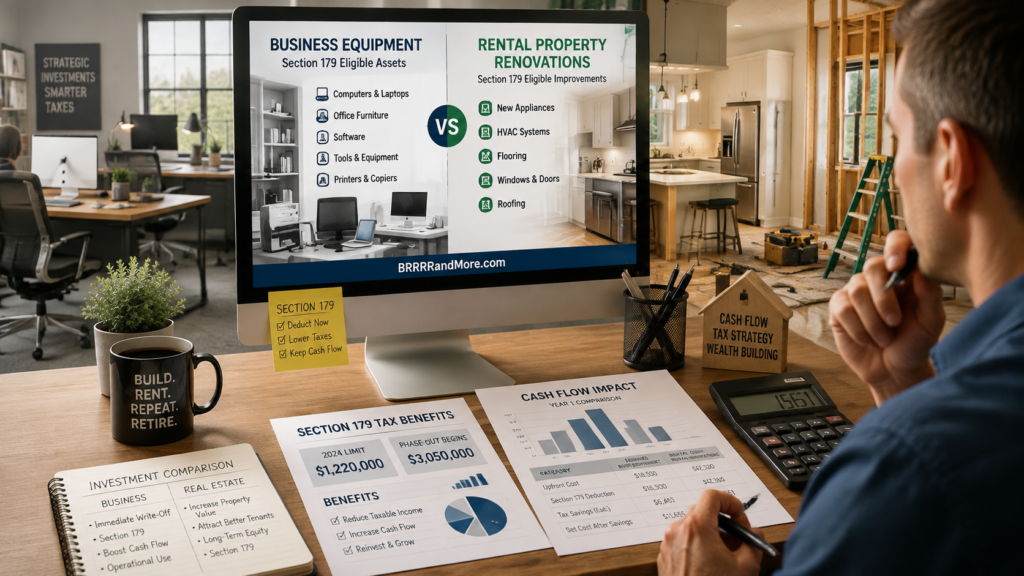
Section 179 becomes relevant to a BRRRR operation at a narrower point than many investors expect.
It usually has more to do with the equipment you use to operate the business than with the rental building you’re renovating.
That line can become blurry when one project includes tools, computers, appliances, HVAC equipment, flooring, landscaping, and structural improvements. Section 179 for BRRRR investors also carries an important restriction when certain property is purchased and then leased to tenants.
Separating business-use equipment from tenant-use property and building improvements helps you identify where Section 179 may legitimately apply—and where MACRS or bonus depreciation is the more relevant rule.
Section 179 Is a Business Expensing Election
Normally, when you purchase a depreciable business asset, you recover its cost through depreciation over the applicable recovery period.
Section 179 can change the timing.
Instead of depreciating qualifying property over several years, you can elect to expense some or all of its qualifying cost in the year you place it in service, subject to the applicable limits.
For 2026, the maximum Section 179 deduction is $2.56 million, with the deduction beginning to phase out when total Section 179 property placed in service exceeds $4.09 million. Those limits are detailed in the IRS Section 179 rules in Publication 946.
For most individual BRRRR investors, those multimillion-dollar limits aren’t the main issue.
Eligibility is.
Your BRRRR Property Isn’t a Section 179 Deduction
Start with the biggest misconception.
You can’t use Section 179 to deduct the cost of a residential rental building.
Buying a $225,000 distressed house and converting it into a rental doesn’t turn the building basis into Section 179 property. The residential building generally follows its applicable MACRS depreciation schedule instead.
Land doesn’t qualify either.
The same problem applies to many major components you install during a rehab. A new roof, structural work, plumbing, and other building improvements don’t become Section 179 deductions just because you paid for them during the renovation.
That’s where generic articles about Section 179 can create confusion for rental investors.
Commercial Property Rules Don’t Transfer to Your Rental House
Federal law allows certain “qualified real property” to receive Section 179 treatment.
That category includes qualified improvement property and certain roofs, HVAC systems, fire-protection systems, and security systems installed in nonresidential real property.
The IRS Form 4562 instructions specifically tie those categories to nonresidential property.
That word matters.
If you replace the HVAC system in an office building, different Section 179 rules may apply. Replace the HVAC system in a residential BRRRR rental and you can’t assume the same treatment.
Residential rental property follows a different path.
The Bigger Trap: Property You Lease to Your Tenant
This rule deserves more attention from residential investors.
Suppose you buy a refrigerator, washer, dryer, and furniture for a rental. They’re tangible personal property, so you may assume they’re perfect Section 179 candidates.
Not necessarily.
Federal law generally prevents a noncorporate lessor from claiming Section 179 on property purchased and leased to someone else unless one of two narrow exceptions applies. The exceptions generally involve property the lessor manufactured or produced, or leases that satisfy specific term and expense tests.
The IRS explains this restriction in Publication 946, and Section 179(d)(5) contains the underlying noncorporate-lessor rule.
For a typical individual investor renting a house to a tenant, that can make the treatment of tenant-use equipment much less straightforward than the usual “buy equipment, take Section 179” advice suggests.
An Appliance Isn’t the Same as a Business Laptop
Consider two purchases.
You buy a $2,000 laptop that you use to operate your active rental business, analyze BRRRR deals, manage contractors, maintain records, and communicate with tenants.
Separately, you buy a $2,000 refrigerator and put it inside a rental for the tenant’s use.
Both are tangible assets.
Their Section 179 analysis can differ because you’re using the laptop directly in your business, while you’re effectively providing the refrigerator as part of the rental arrangement.
That’s an important distinction when considering Section 179 for BRRRR investors.
What May Qualify in a BRRRR Business?
Rather than looking at everything you bought for a property, look at assets you use to operate the business itself.
Depending on your business structure, use, and other requirements, potential Section 179 property might include items such as:
- Computers used for your real estate business
- Office furniture and equipment
- Printers and business electronics
- Power tools used directly in your operation
- Lawn or maintenance equipment you use rather than provide to a tenant
- Certain vehicles that satisfy the business-use requirements
- Other qualifying tangible business equipment
The key question is how you use the asset.
Section 179 property generally must be acquired by purchase for use in the active conduct of a trade or business. Property acquired only to produce investment income doesn’t qualify merely because it generates revenue. The IRS makes that distinction directly in its Section 179 qualification rules.
That makes your underlying rental activity important as well.
A Quick BRRRR Property Check
Here is a more useful way to think about common purchases:
| Purchase | Section 179 outlook |
|---|---|
| Residential rental building | Does not qualify |
| Land | Does not qualify |
| Roof on residential rental | Does not qualify under the qualified-real-property provision |
| Residential HVAC improvement | Does not qualify under the nonresidential improvement provision |
| Fencing or paved parking | Generally not Section 179 property |
| Laptop used to operate an active rental business | May qualify |
| Tools used by you in the rental business | May qualify |
| Office furniture used in the business | May qualify |
| Appliances furnished to a tenant | Noncorporate-lessor restriction may apply |
| Furniture furnished with a rental | Noncorporate-lessor restriction may apply |
The table isn’t a substitute for classifying the actual asset and ownership structure, but it shows why Section 179 isn’t simply another way to deduct your rehab.
What Happens to Assets That Don’t Qualify?
Not qualifying for Section 179 doesn’t mean you lose the deduction.
It usually means you need to look at a different depreciation rule.
A refrigerator installed in a rental might still qualify for regular MACRS depreciation. Depending on the asset, acquisition date, and other requirements, bonus depreciation may also offer accelerated treatment.
The building itself generally follows the residential rental recovery period.
Land improvements and shorter-life property can have their own MACRS classifications.
This is why Section 179, MACRS, cost segregation, and bonus depreciation shouldn’t be treated as interchangeable phrases. They interact, but each has its own rules.
For a BRRRR investor, the practical goal is to put each cost into the correct category first. You can then determine which depreciation or expensing provision applies.
Section 179 Has a Business-Income Limit
Even qualifying property doesn’t guarantee an unlimited current deduction.
Section 179 is subject to a taxable-business-income limitation. Generally, the deduction can’t exceed taxable income derived from the active conduct of trades or businesses for the year.
If an otherwise allowable Section 179 deduction exceeds that limit, the unused amount can generally carry forward.
That creates a different issue from asking whether the property qualifies in the first place.
Imagine you purchase $15,000 of legitimate Section 179 business equipment while building your rental operation. The assets satisfy the property requirements, but your available business income limits how much you can deduct this year.
You may have qualifying assets without receiving the entire deduction immediately.
For smaller BRRRR operators, this limitation can matter more than the headline multimillion-dollar annual cap.
Business Use Needs to Stay Above 50%
Section 179 also comes with a business-use requirement.
When you use an asset for both personal and business purposes, the property generally needs more than 50% business use in the year you place it in service to qualify.
Suppose you purchase equipment and use it 80% for your rental business and 20% personally. Your Section 179 calculation generally starts with the business-use portion rather than the entire purchase price.
Later changes can matter too.
If business use falls to 50% or less before the end of the applicable recovery period, you can trigger Section 179 recapture and have to bring part of the previous deduction back into income.
That issue frequently deserves attention with vehicles, computers, and equipment that can easily move between business and personal use.
Don’t Put Every Rehab Purchase Into the Same Tax Bucket
BRRRR projects create a lot of transactions in a short period.
That makes sloppy classification easy.
A contractor invoice, Home Depot receipt, appliance purchase, laptop, lawn mower, new furnace, and property-management computer may all hit your bank account during the same three-month rehab.
They shouldn’t automatically receive the same tax treatment.
Separate your records into useful categories while the project is happening:
- Building improvements
- Repairs and maintenance
- Appliances and tenant-use property
- Land improvements
- Business tools and equipment
- Office equipment
- Vehicles
- Professional and operating expenses
That organization gives you a much cleaner starting point when you determine whether Section 179, bonus depreciation, regular MACRS depreciation, or another rule applies.
Section 179 or Bonus Depreciation?
For many BRRRR investors, this becomes the more useful question.
Current federal law provides 100% bonus depreciation for qualifying property acquired after January 19, 2025. Unlike Section 179, bonus depreciation follows a different set of eligibility rules and can potentially apply to qualifying property used in an income-producing rental activity.
That can make bonus depreciation more relevant for some assets that don’t fit comfortably within Section 179.
Section 179 still offers flexibility because you can choose which qualifying assets to expense and how much qualifying cost to elect, rather than automatically treating every eligible asset the same way.
The better choice depends on the property, your available business income, other depreciation deductions, and the way the asset is used.
Don’t choose between them based solely on which provision produces the largest deduction on paper.
Use Section 179 for the Business, Not the Building
The most useful way to approach Section 179 for BRRRR investors is to stop thinking of it as a rehab deduction.
Your rental building generally doesn’t qualify. Most structural improvements to a residential rental don’t qualify under the special real-property rules either, and equipment furnished to tenants can run into the noncorporate-lessor restriction.
Section 179 becomes more relevant when you look at the business operating behind the portfolio.
Computers, tools, office equipment, maintenance equipment, and other assets you use directly in an active real estate business may present better candidates.
Keep those purchases separate from your property rehab records. Identify who actually uses each asset, determine whether you’re leasing it to someone else, and establish its business-use percentage.
A BRRRR portfolio can contain plenty of depreciable property.
The important part is knowing which tax rule applies to each piece.