Single-Family BRRRR Case Study: What the Numbers Reveal

This is a hypothetical educational example using composite figures. It does not describe a specific property, transaction, or investor.
A successful BRRRR deal does not have to return every dollar you invested. It does, however, need to produce an acceptable combination of equity, cash flow, capital recovery, and manageable risk.
This single-family BRRRR case study follows an investment from acquisition through refinance. The numbers represent a plausible deal and show how relatively small differences in the rehab budget, appraised value, and holding period can affect the final result.
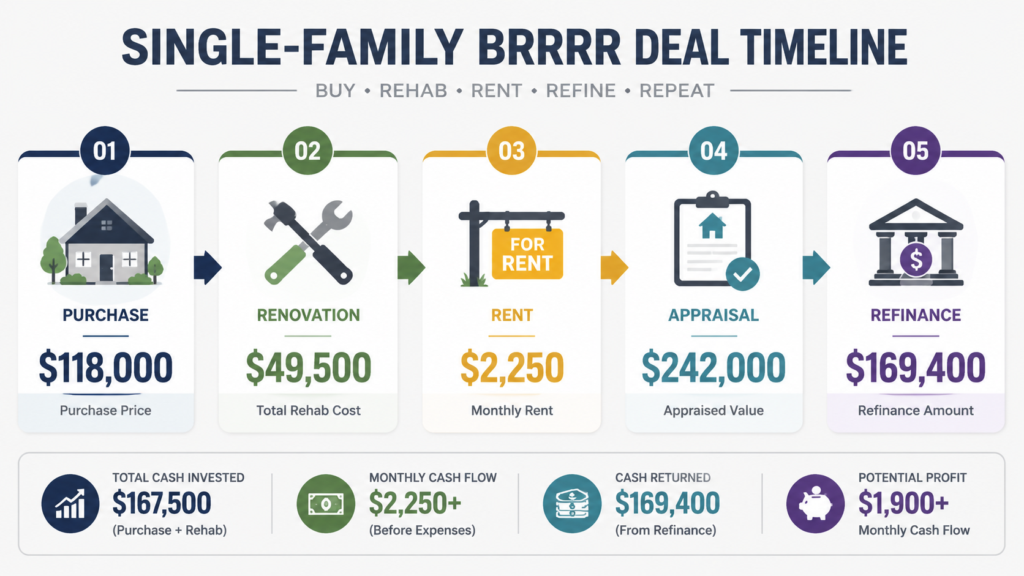
The investor purchased a vacant three-bedroom, two-bathroom house for $118,000. After a $49,500 renovation, the property rented for $2,250 per month and appraised for $242,000. The refinance returned only part of the investor’s cash, leaving $26,600 in the property.
Whether that outcome was acceptable depended on the income, equity, and risks that remained.
Single-Family BRRRR Deal Snapshot
| Deal metric | Result |
|---|---|
| Property type | Three-bedroom, two-bathroom single-family house |
| Purchase price | $118,000 |
| Purchase and lender closing costs | $7,200 |
| Original rehab budget | $45,000 |
| Final rehab cost | $49,500 |
| Holding and financing costs | $13,200 |
| Leasing and stabilization costs | $2,300 |
| Original ARV estimate | $250,000 |
| Final appraised value | $242,000 |
| Monthly rent | $2,250 |
| Refinance loan | $169,400 |
| Cash returned at refinance | $12,400 |
| Capital left in the deal | $26,600 |
| Estimated equity after refinance | $72,600 |
| Estimated monthly cash flow | $235 |
| Project timeline | Seven months |
The project met its basic objectives: the investor acquired a discounted property, improved it, placed a tenant, replaced short-term financing, and retained a rental with positive projected cash flow.
It did not meet the more aggressive goal of recovering nearly all invested capital.
Buying the Property Below Its Stabilized Value
The house was vacant, structurally serviceable, and cosmetically outdated. It needed new flooring, interior paint, kitchen improvements, bathroom repairs, several replacement windows, exterior work, and deferred mechanical maintenance.
The property was not a foreclosure. It was purchased directly from an owner who preferred a quick sale and did not want to complete the repairs.
The acquisition illustrates an important BRRRR principle: the discount must come from a problem you can identify, price, and solve. Describing a house as distressed does not automatically make it a good investment.
The investor offered $118,000 after reviewing comparable sales, obtaining a preliminary repair estimate, and calculating an after-repair value of approximately $250,000.
That appeared to create a $132,000 spread between the purchase price and projected ARV. However, the spread was not profit. Rehab work, financing charges, closing expenses, holding costs, leasing expenses, and refinance limitations all had to be paid from it.
Acquisition Financing and Initial Cash
The investor used a short-term loan covering 90% of the purchase price and up to $45,000 of renovation draws. The maximum principal balance was therefore $151,200.
The investor brought the following cash to closing:
| Cash required at acquisition | Amount |
| 10% down payment | $11,800 |
| Loan points | $3,024 |
| Title, inspection, legal, and prepaid costs | $4,176 |
| Total cash at closing | $19,000 |
Closing costs should be modeled separately from the purchase price. The Consumer Financial Protection Bureau’s explanation of mortgage costs identifies lender charges, points, appraisal fees, title-related charges, and other third-party expenses that can affect the cash required at closing.
An investor loan may use different documentation and pricing, but the underwriting principle remains the same: the purchase price alone does not represent the amount of cash needed to complete the acquisition.
The Rehab Finished Over Budget but Within the Contingency
The original $45,000 rehab budget covered flooring, paint, kitchen work, bathroom repairs, windows, mechanical servicing, exterior repairs, appliances, and contractor labor. The investor also carried a contingency outside the lender-funded renovation budget.
During demolition, the contractor discovered damaged subflooring near one bathroom and more window deterioration than the initial inspection revealed. Those discoveries increased the final renovation cost to $49,500—$4,500 above the original budget.
A 10% overrun did not ruin the deal because the investor had not treated the $45,000 estimate as an absolute ceiling. The additional cost was covered with cash rather than expensive emergency financing.
More importantly, the extra work corrected functional problems that could have caused tenant complaints, recurring maintenance calls, and concerns during the appraisal.
The rehab took four months. The investor then needed approximately two months to complete punch-list work, market the house, approve an applicant, and establish the lease before refinancing.
The refinance process consumed another month, producing a seven-month acquisition-to-refinance timeline.
The Property Rented for $2,250 per Month
The original rent estimate was $2,200. After reviewing updated competing properties and the condition of the renovated house, the investor marketed it at $2,275 and accepted a qualified tenant at $2,250.
The projected stabilized monthly operations were:
| Monthly rental operations | Amount |
| Gross scheduled rent | $2,250 |
| Property taxes | -$250 |
| Insurance | -$125 |
| Property management allowance | -$180 |
| Vacancy allowance | -$113 |
| Maintenance reserve | -$135 |
| Capital expenditure reserve | -$113 |
| Estimated net operating income | $1,334 |
The analysis includes management, vacancy, maintenance, and capital-expenditure allowances even if the investor initially self-manages and does not spend every reserve each month.
Removing those costs would make the cash flow look stronger without changing the property’s underlying obligations. Self-management does not eliminate the value of the investor’s time, and a month without repairs does not mean future repairs have disappeared.
Rental accounting and tax treatment also involve distinctions that a basic cash-flow projection does not capture. The IRS discusses common rental income and expense categories in Publication 527 on residential rental property. Investors should obtain appropriate accounting and tax guidance rather than assume every cash outlay receives the same treatment.
The Appraisal Came In $8,000 Below the Original ARV
The investor underwrote a $250,000 after-repair value, but the completed property appraised for $242,000.
The $8,000 shortfall was manageable, although it reduced the available refinance loan by $5,600 at a 70% loan-to-value ratio.
An appraisal is not a reimbursement of the investor’s project costs. It is an opinion of market value supported by the property’s characteristics, market evidence, and comparable sales. Fannie Mae’s overview of how home appraisals work explains the appraisal’s role in helping a lender determine how much it is prepared to lend.
The investor therefore could not rely on the purchase price plus renovation cost to establish the refinance value. The finished property still had to be supported by its market.
Calculating the Refinance Proceeds
At a $242,000 appraised value and 70% LTV, the new loan was $169,400.
| Refinance calculation | Amount |
| New refinance loan | $169,400 |
| Short-term loan payoff | -$151,200 |
| Refinance closing costs | -$5,800 |
| Net cash returned | $12,400 |
Before refinancing, the investor had contributed $39,000:
- $19,000 at acquisition
- $4,500 for the rehab overrun
- $13,200 in holding and financing costs
- $2,300 for leasing and stabilization
After receiving $12,400 from the refinance, the investor had $26,600 of capital remaining in the property.
Did the Single-Family BRRRR Deal Work?
The answer depends on the investor’s goals.
The new $169,400 loan was modeled at 6.75% over 30 years, producing a principal-and-interest payment of approximately $1,099 per month.
Subtracting that payment from the estimated $1,334 monthly net operating income left approximately $235 in projected monthly pre-tax cash flow, or $2,820 annually.
Based on the $26,600 of capital left in the property, the projected cash-on-cash return was approximately 10.6%.
The investor also retained about $72,600 in gross equity based on the appraisal:
| Equity calculation | Amount |
| Appraised property value | $242,000 |
| Refinance loan balance | -$169,400 |
| Estimated equity | $72,600 |
That equity figure does not account for future selling costs, market changes, or additional capital expenditures. It nevertheless provides a more complete view of the result than cash flow alone.
The figures support a qualified success. The property produced positive projected cash flow, a double-digit cash-on-cash return on the remaining capital, and substantial equity.
However, the investor did not recover enough cash to immediately repeat the same project without additional savings or another source of capital.
What Would Have Changed the Outcome?
The deal was most sensitive to three variables.
First, the appraisal shortfall reduced the refinance proceeds. A $250,000 appraisal at the same 70% LTV would have increased the new loan to $175,000 and reduced the capital left in the deal from $26,600 to $21,000.
Second, the seven-month timeline generated significant carrying costs. Completing and refinancing one month earlier could have preserved approximately one month of interest, insurance, taxes, utilities, and property maintenance.
Third, the refinance LTV controlled how much capital the investor recovered. A higher LTV could have returned more cash, but it also would have increased the mortgage payment and reduced monthly cash flow.
More leverage would not automatically have produced a better investment.
A spreadsheet may be sufficient for a straightforward first-pass analysis. Investors comparing rehab overruns, appraisal values, loan structures, holding periods, and alternative exit strategies may find Rehab Valuator useful for modeling project costs, financing, and exit outcomes before committing to a purchase.
The software should support—not replace—independent repair estimates, contractor bids, lender confirmation, appraisal research, and local rental-market analysis.
Lessons From This Single-Family BRRRR Case Study
The most important lesson is not simply that the investor left $26,600 in the property. It is that the investor understood what that remaining capital produced.
The project created approximately $72,600 in gross equity and an estimated $2,820 in annual pre-tax cash flow. The rehab overrun and lower appraisal weakened the result, but neither caused the investment to fail because the original spread and contingency were sufficient.
A weak analysis might call the deal unsuccessful because the investor did not recover all the contributed cash.
An equally weak analysis might call it an exceptional deal based only on the equity created.
A more complete conclusion considers:
- Cash flow after realistic operating allowances
- Equity after refinancing
- Capital remaining in the property
- Debt service and leverage
- Maintenance and capital reserves
- Execution risk
- The investor’s ability to fund another acquisition
For this investor, the deal worked—but it was a long-term rental acquisition, not a zero-cash miracle.