BRRRR Method Example With Real Numbers
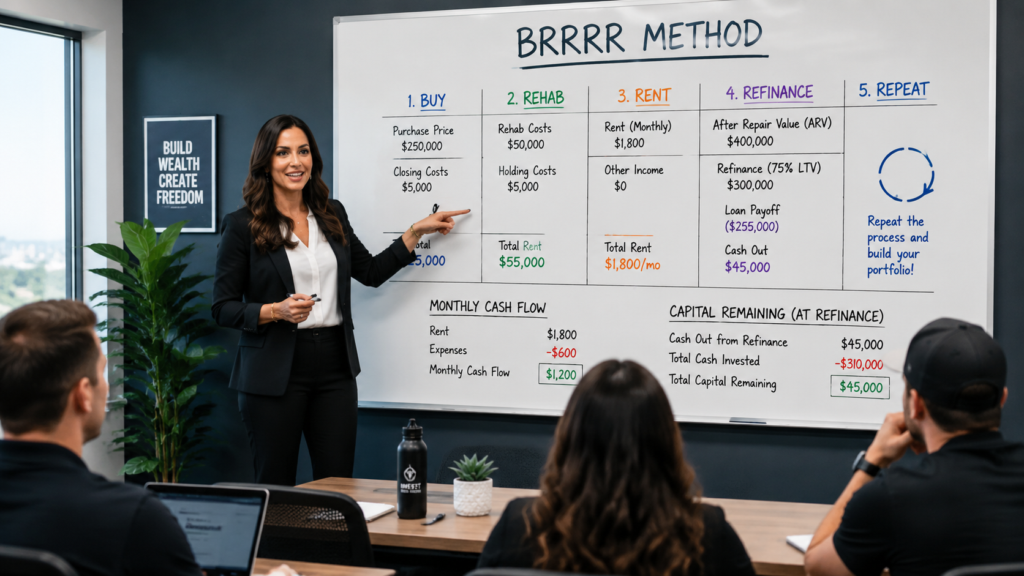
The BRRRR method can sound straightforward when it is reduced to five steps: buy, rehab, rent, refinance, and repeat. The financial outcome becomes less straightforward once you include closing costs, loan fees, holding expenses, operating reserves, refinance costs, and the possibility of a lower appraisal.
This hypothetical BRRRR example follows one single-family rental from acquisition through refinancing. You’ll see how much cash the investor contributes, how the rehabilitation is funded, how refinance proceeds are calculated, how much capital remains in the property, and whether the completed rental produces acceptable cash flow.
The figures are illustrative rather than a description of a particular property. Your costs, loan terms, rent, taxes, insurance, appraisal, and lender requirements will depend on your property and market.
For an explanation of the complete investment framework, begin with how the BRRRR strategy works.
The BRRRR Deal at a Glance
Assume you find a distressed three-bedroom, two-bathroom single-family property in a stable rental neighborhood. The property needs substantial repairs, but renovated homes of similar size and condition have recently sold near $250,000.
Your initial assumptions are:
| Deal component | Amount |
|---|---|
| Purchase price | $125,000 |
| Acquisition closing costs | $4,000 |
| Rehabilitation budget | $45,000 |
| Financing and holding costs | $11,000 |
| Total project cost | $185,000 |
| Projected after-repair value | $250,000 |
| Projected monthly rent | $2,500 |
| Planned refinance LTV | 70% |
| Assumed refinance interest rate | 7.00% |
| Assumed loan term | 30 years |
The projected after-repair value is $65,000 higher than the total project cost:
$250,000 ARV − $185,000 total project cost = $65,000
That spread is important, but it doesn’t tell you whether the project will produce enough refinance proceeds or rental cash flow. You still need to examine every stage separately.
Step 1: Buying the Property
The purchase price is $125,000. You plan to use short-term financing that covers 90% of the purchase price and 100% of the approved rehabilitation budget.
Short-Term Acquisition and Rehab Financing
The purchase portion of the loan is:
$125,000 purchase price × 90% = $112,500
The lender also provides up to $45,000 for the rehabilitation, generally through draws after work is inspected or documented.
| Funding source | Amount |
| Short-term purchase financing | $112,500 |
| Rehabilitation financing | $45,000 |
| Total short-term loan | $157,500 |
| Your cash contribution | $27,500 |
| Total available project funds | $185,000 |
Your $27,500 contribution consists of:
| Initial cash requirement | Amount |
| Purchase down payment | $12,500 |
| Acquisition closing costs | $4,000 |
| Financing and holding costs | $11,000 |
| Total cash contributed | $27,500 |
This calculation assumes the rehabilitation stays within the approved budget and the lender reimburses eligible work as expected. In practice, you may need additional liquidity because rehab lenders often release funds after work is completed. You may have to pay contractors first and wait for the next draw.
What the Acquisition Costs Include
The $4,000 acquisition-cost estimate may include title work, recording charges, legal or settlement services, inspections, and other transaction expenses.
The Consumer Financial Protection Bureau identifies appraisal charges, title insurance, government taxes, and prepaid expenses among the common mortgage closing costs. Your investment-property transaction may involve different disclosures and financing, but the same principle applies: the purchase price is not your complete acquisition cost.
Step 2: Rehabilitating the Property
The property needs enough work to become competitive with renovated rentals and recent comparable sales. The objective is not to install the most expensive finishes. It is to correct deferred maintenance, improve durability, satisfy applicable property requirements, and create a rent-ready home that fits the neighborhood.
Example Rehabilitation Budget
| Rehabilitation item | Budget |
| Roof and exterior repairs | $7,000 |
| HVAC, plumbing, and electrical work | $9,000 |
| Kitchen improvements | $9,000 |
| Bathroom improvements | $5,000 |
| Flooring, paint, and interior trim | $8,000 |
| Permits, cleanup, and landscaping | $2,000 |
| Contingency allowance | $5,000 |
| Total rehabilitation budget | $45,000 |
The $5,000 contingency is approximately 11% of the planned work before contingency. It gives you some protection against concealed damage, material-price changes, revised contractor estimates, and smaller items omitted from the initial scope.
A contingency is not a substitute for a thorough inspection and detailed scope. A roof leak, damaged sewer line, structural defect, unpermitted addition, or obsolete electrical system can exceed a modest reserve quickly.
Financing and Holding Costs
The project also includes $11,000 for expenses that occur while you own and renovate the property.
| Financing or holding expense | Amount |
| Loan origination charges and points | $4,000 |
| Short-term interest | $4,500 |
| Taxes, insurance, and utilities | $1,500 |
| Appraisal, inspections, and miscellaneous costs | $1,000 |
| Total financing and holding costs | $11,000 |
This estimate assumes the property is renovated, leased, and prepared for refinancing within the expected timeline. A contractor delay, permit issue, failed inspection, or extended vacancy could increase interest and carrying costs.
Step 3: Confirming the After-Repair Value
After the renovation, you estimate the property’s market value at $250,000. This figure should be supported by comparable closed sales rather than the amount you spent or the loan you want.
Assume your analysis identifies several nearby renovated properties with similar:
- Living area
- Bedroom and bathroom count
- Property type
- Age and design
- Lot characteristics
- Renovation quality
- Location and school assignment
- Sale date
The Appraisal Foundation’s guidance on identifying comparable properties emphasizes the characteristics and suitability of properties used for comparison. A recently renovated property several neighborhoods away may be less useful than a slightly older sale with a much more comparable location and design.
Your estimated ARV remains an underwriting assumption until an appraisal or completed sale supports it. The investor, lender, appraiser, and market may not reach the same conclusion.
Step 4: Renting the Completed Property
After the renovation, you lease the property for $2,500 per month.
You shouldn’t evaluate the rental using gross rent alone. Vacancy, management, maintenance, taxes, insurance, capital expenditures, and debt service all affect the amount you retain.
Monthly Rental Operating Estimate
| Rental income or expense | Monthly amount |
| Gross scheduled rent | $2,500 |
| Vacancy and credit allowance, 5% | −$125 |
| Property management allowance, 8% | −$200 |
| Repairs and maintenance, 8% | −$200 |
| Property taxes | −$300 |
| Property insurance | −$125 |
| Estimated NOI before capital reserve | $1,550 |
| Capital expenditure reserve, 5% | −$125 |
| Cash available before debt service | $1,425 |
This example includes a management allowance even if you initially plan to manage the property yourself. Your labor has value, and a future buyer or lender may evaluate the property as though professional management is required.
Capital expenditures are shown separately from net operating income because major replacements are commonly treated differently from routine operating expenses. You should still reserve for roofs, HVAC systems, water heaters, appliances, exterior work, and other long-term replacements when evaluating spendable cash flow.
Step 5: Refinancing the Property
Assume the completed property appraises for $250,000 and your lender approves a refinance equal to 70% of the appraised value.
The gross refinance loan is:
$250,000 × 70% = $175,000
Fannie Mae’s general loan-to-value calculation guidance calculates refinance LTV by dividing the loan amount by the current property value. Your actual maximum LTV will depend on the lender, loan program, occupancy, property type, credit profile, income documentation, reserves, and other underwriting requirements.
Calculating Net Refinance Proceeds
The $175,000 loan is not the amount you receive. You must first account for the short-term loan payoff and refinance transaction costs.
Assume refinance costs equal 3% of the new loan:
$175,000 × 3% = $5,250
The proceeds are then calculated as follows:
| Refinance calculation | Amount |
| Gross refinance loan | $175,000 |
| Short-term loan payoff | −$157,500 |
| Refinance closing costs and prepaids | −$5,250 |
| Estimated cash returned to you | $12,250 |
You originally contributed $27,500. After receiving $12,250 from the refinance, your remaining capital is:
$27,500 original contribution − $12,250 returned = $15,250 left in the deal
You do not recover all of your cash. That does not automatically make the project unsuccessful. You now need to compare the capital left in the property with its equity, projected cash flow, leverage, and risk.
Refinance Proceeds Are Not Profit
The $12,250 returned through refinancing is primarily a recovery of your invested capital. It is not the same as operating profit.
The refinance also creates a new $175,000 obligation secured by the property. Your position after closing includes:
- $12,250 of recovered capital
- $15,250 of original capital remaining in the deal
- A $175,000 long-term mortgage
- Approximately $75,000 of gross property equity
- A rental property that must continue supporting its expenses and debt
Gross equity is:
$250,000 property value − $175,000 mortgage = $75,000
That equity is not the same as cash. Accessing it would ordinarily require another loan or a sale, either of which may involve costs, qualifications, and market risk.
Step 6: Calculating Cash Flow After the Refinance
Assume the new $175,000 loan has a 30-year amortization period and a fixed interest rate of 7.00%.
The estimated monthly principal-and-interest payment is approximately:
$1,164 per month
Taxes and insurance were already included in the operating analysis, so they should not be deducted twice.
Your projected monthly cash flow is:
$1,425 cash available before debt service − $1,164 mortgage payment = $261 per month
Projected annual cash flow is:
$261 × 12 = $3,132 per year
This is a planning estimate. Actual cash flow will vary with rent collection, vacancy, repairs, turnover, insurance premiums, taxes, management costs, and major replacements.
Step 7: Calculating Cash-on-Cash Return and DSCR
Two useful measurements are cash-on-cash return and debt service coverage ratio.
Projected Cash-on-Cash Return
Cash-on-cash return compares annual cash flow with the cash that remains invested after refinancing.
$3,132 annual cash flow ÷ $15,250 capital remaining = 20.5%
The projected cash-on-cash return is approximately 20.5%.
That return is based on the assumptions in this example. It does not include income taxes, depreciation, appreciation, transaction costs from a future sale, or the value of your time.
Simplified Debt Service Coverage Ratio
Using the $1,550 monthly NOI before the capital reserve, the simplified property-level DSCR is:
$1,550 NOI ÷ $1,164 debt service = 1.33 DSCR
A 1.33 ratio means the estimated NOI is 1.33 times the monthly principal-and-interest payment.
Actual lender calculations can differ. Some lenders use gross rent compared with principal, interest, taxes, insurance, and association dues. Others use a more detailed net operating income calculation. You should obtain the lender’s exact formula before relying on your projected DSCR.
The Complete Base-Case Result
The base-case outcome can be summarized as follows:
| Result | Amount |
| Total project cost | $185,000 |
| Initial short-term debt | $157,500 |
| Initial cash contributed | $27,500 |
| After-repair value | $250,000 |
| Gross refinance loan | $175,000 |
| Cash returned after payoff and refinance costs | $12,250 |
| Capital remaining in the deal | $15,250 |
| Gross equity after refinancing | $75,000 |
| Projected monthly cash flow | $261 |
| Projected annual cash flow | $3,132 |
| Projected cash-on-cash return | 20.5% |
| Simplified DSCR | 1.33 |
The project produces positive cash flow, retains meaningful equity, and returns part of the investor’s initial capital. It does not produce a complete capital recovery.
What Happens if the Appraisal Is Lower?
The base case assumes a $250,000 appraisal. A lower appraisal reduces the refinance loan and may require you to leave substantially more cash in the property.
Assume the lender still offers 70% LTV and refinance costs remain 3% of the new loan.
| Appraised value | Gross refinance loan | Refinance costs | Cash returned or required | Capital left in deal | Estimated monthly cash flow |
| $250,000 | $175,000 | $5,250 | $12,250 returned | $15,250 | $261 |
| $235,000 | $164,500 | $4,935 | $2,065 returned | $25,435 | $331 |
| $225,000 | $157,500 | $4,725 | $4,725 required | $32,225 | $377 |
At a $235,000 appraisal, you recover only $2,065. Your long-term mortgage is smaller, so projected monthly cash flow improves, but substantially more of your capital remains invested.
At a $225,000 appraisal, the gross refinance loan equals the short-term principal balance. After closing costs, you would need to bring approximately $4,725 to the refinance closing.
A lower appraisal can therefore improve monthly cash flow by reducing the permanent loan while simultaneously creating a liquidity problem.
What Happens if the Rehab Costs $10,000 More?
Assume the rehabilitation ultimately costs $55,000 instead of $45,000 and the additional $10,000 is not financed.
Your cash contribution increases from $27,500 to $37,500.
If the property still appraises for $250,000 and the refinance still returns $12,250, your capital remaining becomes:
$37,500 contributed − $12,250 returned = $25,250
Projected annual cash flow remains approximately $3,132 because the permanent loan and rent did not change.
The revised cash-on-cash return is:
$3,132 ÷ $25,250 = 12.4%
The project may still be viable, but the rehab overrun reduces the projected cash-on-cash return from 20.5% to approximately 12.4%.
What Happens if the Rent Is Only $2,300?
A property can reach its projected value but fail to achieve its projected rent.
Assume monthly rent is $2,300 while the tax, insurance, refinance, and debt assumptions remain unchanged. Applying the same percentage allowances produces approximately:
| Rental income or expense | Monthly amount |
| Gross scheduled rent | $2,300 |
| Vacancy allowance, 5% | −$115 |
| Management allowance, 8% | −$184 |
| Repairs and maintenance, 8% | −$184 |
| Property taxes | −$300 |
| Property insurance | −$125 |
| NOI before capital reserve | $1,392 |
| Capital expenditure reserve, 5% | −$115 |
| Cash available before debt service | $1,277 |
| Mortgage payment | −$1,164 |
| Projected monthly cash flow | $113 |
Annual cash flow falls to approximately $1,356.
Based on the original $15,250 remaining investment, projected cash-on-cash return falls to approximately:
$1,356 ÷ $15,250 = 8.9%
A $200 monthly rent shortfall reduces projected monthly cash flow by $148 because some operating allowances also decline with rent. The property remains positive in this simplified example, but its margin for repairs, vacancy, and other surprises becomes much smaller.
Analyzing more than one scenario? Manual calculations help you understand how a BRRRR deal works, but comparing different purchase prices, rehab budgets, rents, financing terms, and exit strategies can become time-consuming. Rehab Valuator provides more advanced deal analysis, rehab budgeting, and investor and lender reporting when you need to evaluate multiple scenarios in greater detail.
Why Not Refinance at 75% LTV?
A higher-LTV refinance could return more of your capital.
At 75% of a $250,000 appraisal:
$250,000 × 75% = $187,500
Assuming 3% refinance costs:
| Higher-LTV refinance calculation | Amount |
| Gross refinance loan | $187,500 |
| Short-term loan payoff | −$157,500 |
| Refinance costs | −$5,625 |
| Estimated cash returned | $24,375 |
| Capital remaining | $3,125 |
This nearly recovers your entire $27,500 contribution. However, the larger loan increases the projected principal-and-interest payment to approximately $1,247 per month.
Monthly cash flow declines to approximately:
$1,425 − $1,247 = $178
The simplified DSCR also declines from approximately 1.33 to 1.24.
The projected cash-on-cash return appears extremely high because only $3,125 remains in the property. That percentage can be misleading when viewed without context. You have less equity, higher debt service, thinner coverage, and less protection against lower rent or rising expenses.
Recovering more cash is not automatically the safest outcome.
Can You Immediately Repeat the Process?
The refinance returns $12,250, but the original project required $27,500 of investor cash. You don’t yet have enough recovered capital to repeat an identical transaction without using additional savings, a partner, another financing source, or accumulated cash flow.
“Repeat” should not be interpreted as an obligation to purchase another property immediately.
Before starting the next project, you should consider whether you have enough liquidity to cover:
- The next down payment
- Acquisition costs
- Rehab draw delays
- Cost overruns
- Loan extensions
- Vacancy
- Repairs on the completed property
- Personal or portfolio emergencies
A successful refinance can improve your capital efficiency without returning every dollar. Repeating too quickly can create a liquidity problem across several otherwise viable properties.
What Makes This BRRRR Example Work?
Several factors support the base-case result.
The Purchase Price Leaves Room for Improvement
The property is acquired for $125,000 and has a projected completed value of $250,000. The value spread is large enough to absorb the rehabilitation and other project costs.
The Rehabilitation Has a Defined Purpose
The $45,000 budget addresses property condition, durability, marketability, and rent readiness. It is not based primarily on cosmetic preferences.
The Rent Supports the Permanent Debt
The $2,500 rent produces projected cash flow after vacancy, management, repairs, taxes, insurance, capital reserves, and mortgage payments.
The Deal Does Not Require Full Capital Recovery
The investor leaves $15,250 in the property under the base case. The project is not dependent on recovering every dollar at the refinance closing.
The Property Has More Than One Potential Exit
If the refinance is delayed or reduced, the investor may be able to continue holding the rented property, refinance later, use a different loan product, contribute more cash, or sell if market conditions and transaction costs support that decision.
What Could Cause the Deal to Fail?
The same deal becomes weaker if several assumptions move in the wrong direction.
Potential problems include:
- The appraisal is substantially below $250,000.
- The rehab exceeds its budget.
- Contractors or permits extend the project timeline.
- The property rents for less than $2,500.
- Taxes or insurance are higher than projected.
- The refinance interest rate increases.
- The lender offers a lower LTV.
- The property or borrower fails to satisfy refinance requirements.
- The short-term loan matures before permanent financing is available.
- A major repair occurs soon after the property is rented.
- The investor lacks enough cash to fund draws, overruns, or closing requirements.
A strong deal should survive more than one mild disappointment. If the project works only when the appraisal, rehab, timeline, rent, and refinance are all perfect, the margin for error is too small.
Key Lessons From the Numbers
This example demonstrates several principles you can apply to your own analysis.
First, total project cost matters more than purchase price alone. The $125,000 property actually requires $185,000 after rehabilitation, acquisition, financing, and holding costs.
Second, a gross refinance loan is not the amount returned to you. Existing debt, lender charges, title expenses, escrows, and prepaid items reduce your proceeds.
Third, capital remaining in the property is not necessarily a failure. The relevant question is whether the retained equity, cash flow, leverage, and expected return justify the amount still invested.
Fourth, higher leverage can return more cash while weakening monthly coverage. Maximizing refinance proceeds and building a stable rental are related objectives, but they are not always the same objective.
Finally, appraisal, rent, rehab cost, and financing should be analyzed together. A deal with strong equity can still have weak cash flow, and a property with positive cash flow can still create a refinancing or liquidity problem.
Final Perspective
In this hypothetical BRRRR example, you purchase a property for $125,000, spend $45,000 on rehabilitation, and incur $15,000 in acquisition, financing, and holding costs. Your total project cost is $185,000.
After completing the renovation, you rent the property for $2,500 per month and refinance it at 70% of a $250,000 appraised value.
The refinance returns approximately $12,250 of your original $27,500 contribution, leaving $15,250 invested in the property. The completed rental holds approximately $75,000 in gross equity and produces projected monthly cash flow of $261.
The result is financially promising, but it is not effortless or risk-free. A lower appraisal, rehab overrun, rent shortfall, financing change, or extended timeline can materially change the outcome.
Use the BRRRR framework to coordinate acquisition, renovation, rental operations, and financing. Don’t use it as a reason to force a property into a strategy that its numbers cannot support.
This article is for general educational purposes and does not provide legal, tax, lending, appraisal, construction, or investment advice. Financing requirements, property laws, expenses, and market conditions vary. Verify material assumptions with qualified local professionals before making an investment decision.