Does the BRRRR Method Still Work?
Yes, the BRRRR method can still work—but it doesn’t work automatically.
The strategy remains viable when you purchase at the right price, complete renovations that create measurable value, secure sufficient rent, qualify for permanent financing, and maintain enough liquidity to withstand delays or unfavorable changes.
What has changed is the margin for error.
You may face higher acquisition costs, fluctuating interest rates, expensive insurance, rising property taxes, tighter contractor availability, conservative appraisals, or lender requirements that differ from your initial assumptions. A deal that appears profitable during a quick first review may become much less attractive once those variables are included.
The BRRRR method is not obsolete. It simply requires disciplined underwriting and a realistic definition of success.
For a complete overview of each stage, review our guide to the BRRRR strategy and how it works.
What Does It Mean for a BRRRR Deal to Work?
Before deciding whether the strategy still works, you need to define what a successful outcome looks like.
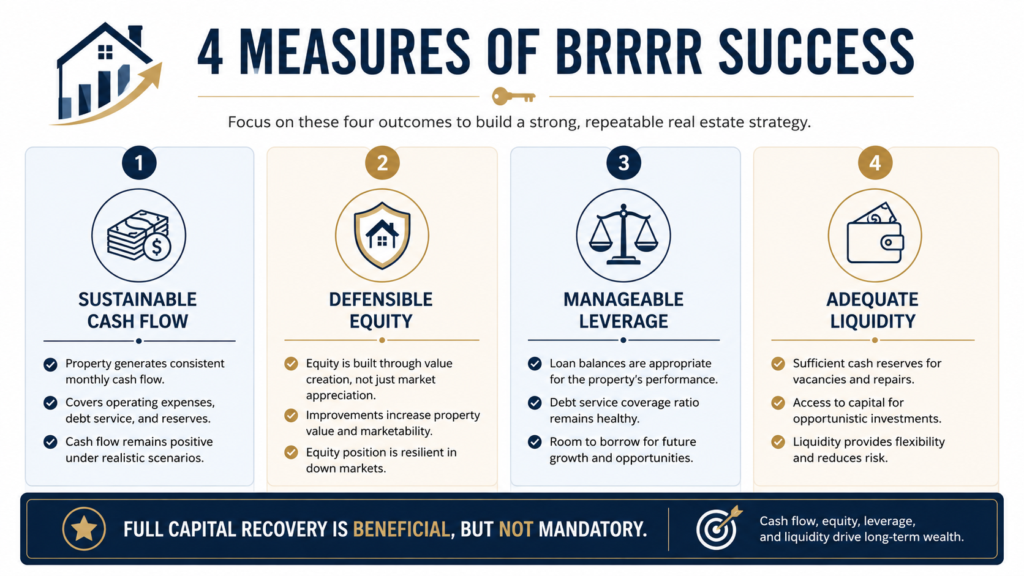
Some investors consider a BRRRR deal successful only when the refinance returns all the cash they invested. That is one possible result, but it is not the only reasonable standard.
A deal may still work when it produces:
- Positive and durable rental cash flow
- Equity based on a defensible property value
- A manageable long-term mortgage
- Adequate debt-service coverage
- Partial recovery of the investor’s capital
- A stable rental that supports long-term portfolio growth
Suppose you invest $40,000 and recover $30,000 through refinancing. You still have $10,000 in the property. If the property also has substantial equity, produces reliable cash flow, and maintains adequate reserves, the deal may represent an effective use of capital.
By contrast, recovering every dollar does not necessarily make the deal strong. A highly leveraged property with minimal cash flow and weak debt coverage may expose you to more risk than a property in which you leave some capital invested.
Full Capital Recovery Is Not the Only Measure
The phrase “infinite return” is sometimes used when an investor recovers all invested capital and continues receiving rental income.
That outcome is possible, but it shouldn’t be your minimum requirement for every deal.
Making complete capital recovery mandatory may encourage you to:
- Use an overly optimistic after-repair value
- Borrow at an unnecessarily high loan-to-value ratio
- Underestimate refinance costs
- Ignore future repairs and reserves
- Accept thin monthly cash flow
- Assume appreciation will correct a weak acquisition
A better question is whether the completed property provides an acceptable return for the cash, equity, debt, time, and risk involved.
Why Investors Question Whether BRRRR Still Works
The BRRRR method often appears easiest when property prices are rising rapidly, borrowing costs are low, and renovated homes appraise above expectations.
Those conditions can make strong deals more profitable. They can also make weak deals appear successful.
When market conditions become less forgiving, the same strategy requires more careful execution.
Financing Costs Can Change the Refinance Outcome
The permanent loan determines both the amount of capital you can recover and the monthly debt payment you must support.
Mortgage rates fluctuate over time, as shown by Freddie Mac’s long-running mortgage-rate survey. Although investor and rental-property loan rates may differ from conventional owner-occupied mortgage rates, broader rate movements still affect lending costs and investor expectations.
A higher interest rate can:
- Reduce monthly cash flow
- Lower the maximum loan supported by the rent
- Weaken the debt service coverage ratio
- Make a lender more conservative
- Reduce the amount of debt you are willing to place on the property
You shouldn’t analyze the refinance using the most favorable rate you can find. Use a reasonable expected rate and test the deal at a higher rate as well.
Purchase Prices May Not Adjust as Quickly as Financing Costs
Sellers may continue expecting prices based on prior market conditions even when buyers face more expensive financing.
That can compress the spread between:
- Purchase price
- Rehabilitation cost
- Total project cost
- After-repair value
- Maximum refinance amount
The BRRRR method depends heavily on that spread. If you pay too much at acquisition, the remaining stages may not repair the economics of the deal.
Rehabilitation Costs Can Be Difficult to Control
Labor, material, permit, and carrying costs can vary substantially.
A rehabilitation that exceeds its budget creates two problems:
- You invest more cash than planned.
- The added spending may not increase the property’s value by an equal amount.
Spending another $15,000 does not guarantee that the appraisal will increase by $15,000. Cost and value are related, but they are not interchangeable.
Insurance and Property Taxes Can Reduce Cash Flow
Investors sometimes concentrate on principal and interest while giving less attention to taxes and insurance.
Those expenses can change independently of rent. A reassessment after purchase or renovation may increase the tax bill. Insurance premiums may rise because of location, property age, roof condition, claims history, or regional risk.
A property that appears to produce $400 per month may produce far less after updated taxes and insurance are included.
Appraisals Can Be More Conservative Than Investor Projections
Your after-repair value is an estimate until the property is completed and appraised.
Market trends can provide useful context, but national appreciation does not determine the value of an individual property. The FHFA House Price Index tracks changes in single-family home values across multiple geographic levels, illustrating how price movement can differ by market.
Your refinance appraisal will depend more directly on the subject property, its condition, and appropriate comparable sales.
A BRRRR deal should not require an unusually aggressive appraisal to survive.
Why the BRRRR Method Can Still Work
The strategy remains viable because its core economic principles have not disappeared.
You are still attempting to:
- Acquire a property below its stabilized value.
- Improve its condition and usefulness.
- Convert it into an income-producing rental.
- Replace short-term financing with sustainable long-term debt.
- Redeploy recovered capital into another opportunity.
None of those principles depends entirely on low interest rates or rapid appreciation.
You Can Create Value Through the Rehabilitation
BRRRR is different from a passive buy-and-hold acquisition because part of the value is created through execution.
You may improve value by:
- Correcting serious deferred maintenance
- Making the property financeable or insurable
- Improving the layout
- Adding a legally permitted bedroom or bathroom
- Increasing durability and reducing maintenance
- Bringing an uninhabitable property into rentable condition
- Improving the property to match appropriate comparable homes
The key is to renovate according to the property, market, tenant base, and likely appraisal—not according to personal preferences.
Distressed and Poorly Managed Properties Still Exist
Even competitive markets contain properties with problems that discourage conventional buyers.
Possible opportunities include:
- Deferred maintenance
- Poor presentation
- Vacant properties
- Inherited properties
- Landlord fatigue
- Code violations
- Tenant or management problems
- Incomplete renovations
- Properties that cannot qualify for conventional financing
The opportunity does not come solely from finding a cheap house. It comes from identifying a problem you can solve at a cost that leaves an adequate margin.
Rental Income Can Support a Long-Term Hold
A BRRRR deal does not need immediate appreciation if the stabilized rental supports its operating expenses, reserves, and debt.
Rent is not guaranteed, however. You must evaluate both market rent and rental demand.
National resources such as the U.S. rental vacancy data published through FRED can provide broad context, but your decision should depend on local vacancy, competing listings, property type, condition, tenant demand, and achievable rent.
The rent assumption should be based on comparable rental properties rather than the amount needed to make your spreadsheet work.
Refinancing Can Improve Capital Efficiency
Refinancing allows you to replace expensive short-term debt with financing intended for a longer holding period.
Depending on the lender and loan product, the refinance may:
- Pay off the acquisition and rehab loan
- Return part of your original cash
- Return most or all of your original cash
- Reduce interest-rate or maturity risk
- Convert the property into a stable long-term asset
The refinance is a funding transition, not the creation of free money. Every dollar returned is supported by a new loan secured by the property.
The Five Conditions a BRRRR Deal Must Satisfy
A viable BRRRR deal must work at every major stage. A strong purchase alone is not enough.
1. The Acquisition Basis Must Be Low Enough
Your acquisition basis includes more than the purchase price.
It may include:
- Purchase price
- Buyer closing costs
- Loan points and origination charges
- Inspection and appraisal costs
- Legal or title costs
- Initial insurance
- Taxes and utilities
- Security and property preservation
- Immediate cleanup
- Financing interest
- Rehabilitation expenses
- Contingency reserves
You need enough distance between the total project cost and the expected stabilized value.
A property purchased for $140,000 is not necessarily a better deal than one purchased for $170,000. The first may require $100,000 of work, while the second may require only $35,000.
Compare the full project economics, not the purchase prices in isolation.
2. The Rehabilitation Must Create Useful Value
A successful rehabilitation should make the property safer, more durable, more rentable, and more competitive with the relevant sales comparables.
The work should have a clear purpose.
High-Priority Improvements
These often include:
- Roof, foundation, drainage, and structural work
- Electrical, plumbing, and HVAC systems
- Safety and code issues
- Water intrusion and environmental problems
- Functional kitchens and bathrooms
- Durable flooring and finishes
- Energy or utility improvements where economically justified
- Exterior repairs that protect the building
Lower-Priority Improvements
These may include:
- Premium finishes unsupported by local rents
- Highly personalized design choices
- Excessive landscaping
- Luxury fixtures in a workforce-rental market
- Layout changes that do not improve function or value
The correct renovation is not necessarily the cheapest scope or the most extensive scope. It is the work needed to produce the intended rental and valuation outcome without unnecessary spending.
3. The Rent Must Support the Completed Property
Gross rent is only the beginning of rental analysis.
You should account for:
- Vacancy and nonpayment
- Property management
- Repairs and routine maintenance
- Property taxes
- Insurance
- Utilities paid by the owner
- Association fees
- Leasing and turnover
- Lawn, snow, pest, or common-area expenses
- Capital expenditures
- Mortgage payments
A property may rent for $2,000 per month and still have weak cash flow if taxes, insurance, and maintenance are unusually high.
Use More Than One Rent Scenario
At minimum, evaluate:
- Expected rent
- Rent 5% below expectations
- Rent 10% below expectations
Also test a period of vacancy or a costly turnover.
A deal that becomes unmanageable after a modest rent shortfall does not have enough operating margin.
4. The Refinance Must Be Realistic
You should investigate permanent financing before purchasing the property—not after the rehab is complete.
Ask potential lenders about:
- Maximum loan-to-value ratio
- Minimum credit requirements
- Income documentation
- Debt service coverage requirements
- Property seasoning
- Cash-out seasoning
- Appraisal standards
- Eligible property types
- Required reserves
- Entity ownership
- Lease requirements
- Prepayment penalties
- Minimum and maximum loan amounts
- Treatment of recent renovation costs
Different lenders may calculate the same property differently.
One may base the loan on appraised value. Another may restrict proceeds according to your documented cost basis. One may accept projected market rent, while another may require an executed lease.
A verbal estimate is not a loan commitment. Build the deal around conservative terms and confirm the requirements directly with prospective lenders.
5. You Must Have Enough Liquidity
Many BRRRR failures are liquidity failures rather than permanent property failures.
The project may still have equity and long-term potential, but you can run out of cash before reaching stabilization.
You may need liquidity for:
- Contractor deposits
- Rehab draws paid in arrears
- Unexpected repairs
- Loan extensions
- Additional interest
- Appraisal shortfalls
- Refinance closing costs
- Lease-up expenses
- Vacancy
- Initial maintenance
- Taxes and insurance
- Cash required at refinance closing
Do not invest your final available dollar in the down payment and initial rehab.
A reserve is not idle money. It is part of the project’s risk management.
When the BRRRR Method Works Best
BRRRR tends to work best when several favorable characteristics occur together.
The Property Has a Solvable Problem
The property should be discounted for a reason you can address.
A dated interior, deferred maintenance, damaged finishes, outdated systems, or poor management may be solvable. A declining location, uncorrectable flood risk, severe environmental contamination, or structurally obsolete design may be more difficult.
You want a problem that requires expertise and execution—not a problem that remains after the renovation.
The Market Has Stable Rental Demand
You don’t necessarily need rapid population growth or dramatic appreciation.
You do need enough demand to lease the property at a rent that supports the completed project.
Useful local indicators include:
- Days on market for comparable rentals
- Number of competing listings
- Concessions offered by landlords
- Tenant income and employment
- School, transportation, and neighborhood access
- New rental construction
- Eviction and turnover patterns
- Property tax and insurance trends
Stable rent and occupancy may be more important than headline appreciation.
Comparable Sales Support the ARV
The best after-repair values are supported by several relevant sales rather than one unusually high transaction.
Your comparables should be reasonably similar in:
- Location
- Property type
- Size
- Age
- Condition
- Layout
- Lot
- Renovation quality
- Sale date
The greater the adjustments needed to make a comparable resemble the subject property, the less certainty you may have in the estimate.
The Deal Has More Than One Exit Strategy
Your primary plan may be to refinance and retain the property.
You should still understand your alternatives.
Possible backup plans include:
- Leave more cash invested and complete a smaller refinance
- Use a different permanent lender
- Hold the short-term loan longer if an extension is available
- Pay down part of the acquisition debt
- Partner with another investor
- Sell the completed property
- Sell before completing the entire scope
- Retain the property with alternative financing
A backup exit is useful only when it is realistic. Selling may not solve the problem if transaction costs eliminate the projected profit.
When the BRRRR Method Does Not Work Well
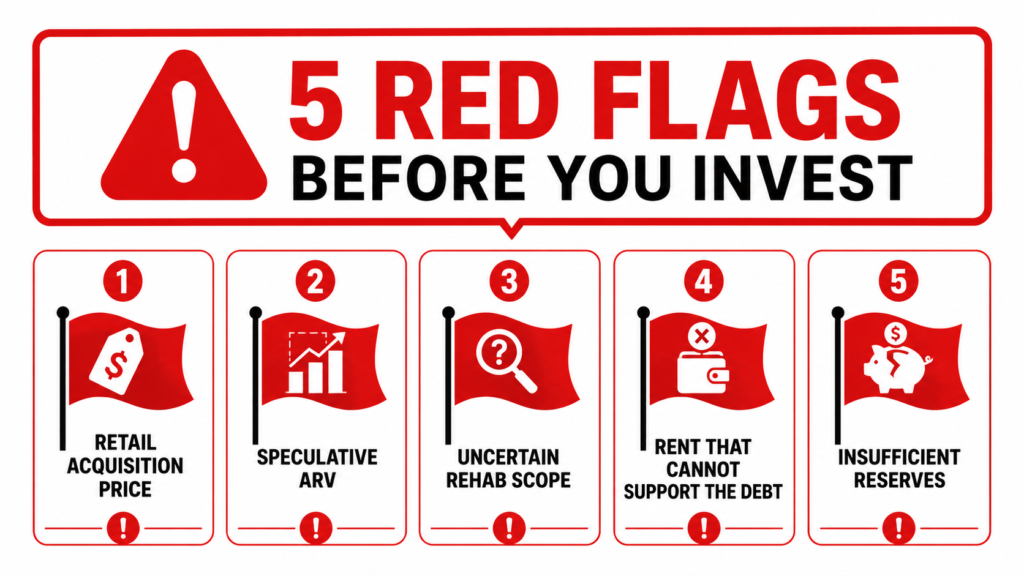
BRRRR is not the correct strategy for every property or investor.
You Have to Pay Retail Price
Buying at or near the value of a renovated property leaves little room for the rehab, financing costs, refinance expenses, or errors.
A large renovation budget does not automatically create a large value increase.
The Property Requires Speculative Appreciation
The deal should not depend on the market appreciating substantially during the rehab.
Appreciation can improve the result, but it should not be used to fill a gap that exists at acquisition.
The Rent Cannot Support the Refinance
A high appraisal may allow a large loan based on LTV, but the rent may not support the resulting payment.
This is especially important with DSCR financing. The property may have enough equity while failing the lender’s rent-coverage requirement.
The Rehab Scope Is Uncertain
Properties with structural movement, extensive water damage, fire damage, environmental hazards, or incomplete additions can contain major unknowns.
These deals may still work for experienced operators, but they require specialized inspections, larger contingencies, and appropriate financing.
The Timeline Is Too Tight
Short-term loans commonly have maturity dates and extension requirements.
If the expected schedule allows no room for contractor delays, permitting, inspections, leasing, seasoning, or appraisal disputes, you are relying on perfect execution.
Your Financial Position Is Too Fragile
Even a promising property may be inappropriate if one cost overrun or delayed refinance would create personal financial distress.
The method involves construction, leasing, financing, and long-term ownership risks. Your personal liquidity and borrowing capacity matter.
How Different Market Conditions Affect BRRRR
The method can operate in different environments, but your underwriting must change.
| Market condition | Primary risk | Appropriate adjustment |
|---|---|---|
| Higher interest rates | Lower cash flow and loan proceeds | Use conservative refinance rates and lower leverage |
| Flat property values | Little help from appreciation | Require value creation at acquisition and rehab |
| Rising rehab costs | Budget overruns | Obtain detailed scopes and larger contingencies |
| Soft rental demand | Vacancy and concessions | Use lower rent and longer lease-up assumptions |
| High taxes or insurance | Reduced NOI and DSCR | Verify actual costs before making an offer |
| Tight lending standards | Smaller or delayed refinance | Confirm lender terms and maintain extra liquidity |
| Competitive acquisitions | Overpaying | Maintain firm offer limits and reject marginal deals |
| Rapid appreciation | Overconfidence | Underwrite from current evidence, not expected growth |
The BRRRR method does not stop working because one market variable becomes less favorable. The deal must compensate elsewhere.
For example, higher financing costs may require:
- A lower acquisition price
- A smaller permanent loan
- Higher rent relative to value
- More cash left in the deal
- A larger cash-flow margin
- A different property or market
You can’t control the market, but you can control the assumptions you accept.
How to Stress-Test a BRRRR Deal
A single base-case projection is not enough.
Before making an offer, test several unfavorable scenarios.
Lower Appraisal
Calculate the refinance using an ARV that is:
- 5% below your estimate
- 10% below your estimate
- Equal to the lower end of the comparable range
Determine how much additional cash would remain in the property or be required at closing.
Higher Rehab Cost
Increase the rehab by:
- 10%
- 15%
- The estimated cost of one major unknown repair
Measure the effect on capital remaining and overall return.
Longer Project Timeline
Add several months of:
- Interest
- Taxes
- Insurance
- Utilities
- Lawn or snow service
- Loan extension charges
Timeline risk is often underestimated because it does not appear in the contractor’s bid.
Lower Rent
Reduce expected rent and add a leasing delay.
Calculate whether the property still covers:
- Operating expenses
- Capital reserves
- Debt payments
- Minimum lender requirements
Higher Refinance Rate
Increase the expected permanent rate by at least one percentage point.
Then recalculate:
- Monthly payment
- Cash flow
- DSCR
- Maximum acceptable loan amount
Lower Refinance LTV
If your base case assumes 75% LTV, test the deal at 70% and 65%.
A lower loan may improve monthly cash flow but return less capital.
Comparing several scenarios? A spreadsheet can handle a basic first review, but complex projects may require more detailed rehab estimates, financing comparisons, and exit analysis. Rehab Valuator provides advanced BRRRR deal analysis, rehab budgeting, and investor and lender reporting when you need to evaluate the project in greater detail.
A Simple BRRRR Viability Test
Before proceeding, ask the following questions.
Purchase
- Is the total acquisition basis below the property’s conservative stabilized value?
- Is the discount supported by evidence rather than an asking-price comparison?
- Have you included closing, financing, and holding costs?
Rehab
- Is the scope based on inspections and contractor estimates?
- Does each major improvement support safety, rentability, durability, or value?
- Is there an adequate contingency?
Rent
- Is projected rent supported by comparable properties?
- Does cash flow remain positive at a lower rent?
- Are taxes, insurance, vacancy, management, maintenance, and reserves included?
Refinance
- Have you discussed the completed project with potential lenders?
- Do you understand LTV, DSCR, seasoning, appraisal, and reserve requirements?
- Can the deal survive a lower appraisal or smaller loan?
Liquidity
- Can you fund rehab draws and unexpected costs?
- Can you carry the property through delays?
- Will you still have reserves after the refinance?
Long-Term Hold
- Would you want to own the property if appreciation is minimal?
- Is the debt sustainable?
- Can you manage the property or hire qualified management?
- Does the projected return justify the risk and effort?
If several answers depend on favorable assumptions, the deal may not be strong enough.
Does BRRRR Work for Beginners?
It can, but the method combines several disciplines:
- Property acquisition
- Construction management
- Rental analysis
- Leasing
- Lending
- Appraisal
- Property management
- Risk and cash-flow management
A beginner may reduce risk by choosing a property with a straightforward renovation, conventional layout, strong comparable sales, and established rental demand.
Your first project does not need to produce the highest possible return. A simpler project with a wider margin for error may provide a better foundation for future investments.
You should also build a team before closing, including appropriate professionals such as:
- Real estate agent or broker
- Property inspector
- Licensed contractors
- Insurance agent
- Lender or mortgage broker
- Title or settlement professional
- Property manager
- Attorney and tax professional where needed
The presence of professionals does not eliminate your responsibility for the numbers. It improves the quality of the information you use.
Does BRRRR Work Without Rapid Appreciation?
Yes, provided the acquisition and renovation create sufficient value and the property works as a rental.
A conservative BRRRR analysis should assume limited or no short-term appreciation.
Your projected equity should primarily come from:
- Buying below stabilized value
- Solving a property problem
- Completing an effective rehabilitation
- Controlling project costs
- Paying down debt over time
Market appreciation is beneficial, but relying on it turns a value-add strategy into a speculation on future pricing.
Does BRRRR Work With Higher Interest Rates?
It can, but the deal must support the higher debt cost.
Higher rates may require you to:
- Buy at a lower price
- Borrow less
- Leave more cash invested
- Select a property with a stronger rent-to-price relationship
- Reduce nonessential renovation spending
- Accept slower portfolio growth
- Wait for a better opportunity
You should not assume that rates will fall before the refinance.
If rates decline, you may benefit. If they do not, the deal should remain sustainable under the financing available when you underwrite it.
Does BRRRR Work if You Leave Money in the Deal?
Yes.
Leaving cash in the property is not automatically a failed BRRRR.
Suppose you leave $20,000 invested in a property that has:
- $70,000 in gross equity
- Positive cash flow after reserves
- Sustainable long-term financing
- Strong rental demand
- A reasonable projected return
That may be a sound investment.
The relevant calculation is not simply whether any cash remains. You should evaluate:
- Capital remaining
- Annual cash flow
- Cash-on-cash return
- Equity
- Debt-service coverage
- Future repair obligations
- Liquidity
- Alternative uses of the capital
A poor deal can return all your money. A good deal can require you to leave some money invested.
Is the BRRRR Method Too Competitive?
Competition makes acquisitions harder, but it does not affect every property, seller, or market equally.
You may improve your chances by:
- Developing relationships with local agents
- Contacting property managers and landlords
- Reviewing stale or failed listings
- Following up consistently
- Examining small multifamily properties
- Looking beyond purely cosmetic renovations
- Building contractor and lender relationships
- Specializing in a property type or neighborhood
- Making offers based on disciplined limits
The goal is not to find a secret source with no competition. It is to analyze opportunities accurately and execute more reliably than buyers who rely on optimistic assumptions.
The Final Answer
The BRRRR method still works when the deal creates real value, produces sustainable rental income, qualifies for realistic permanent financing, and leaves you with adequate reserves.
It works poorly when you:
- Overpay
- Underestimate the rehab
- Overstate the ARV
- Assume maximum refinance proceeds
- Ignore operating expenses
- Depend on appreciation
- Carry insufficient cash
- Scale faster than your finances and systems allow
The strategy should be evaluated as a coordinated investment process—not as five independent steps.
Your purchase price affects the rehab budget. The rehab affects the appraisal and rent. The appraisal and rent affect the refinance. The refinance affects cash flow and capital recovery. All five stages affect whether you can safely repeat the process.
The question is therefore not simply, “Does BRRRR still work?”
The more useful question is:
Does this specific property work under conservative purchase, rehab, rental, refinance, and holding assumptions?
When the answer is supported by evidence—and the deal can survive reasonable setbacks—the BRRRR method remains a viable way to create and retain long-term rental properties.
This article is for general educational purposes and does not provide legal, tax, lending, appraisal, construction, or investment advice. Financing requirements, property laws, expenses, and market conditions vary. Verify material assumptions with qualified local professionals before making an investment decision.