BRRRR vs. Buy and Hold Real Estate

BRRRR and buy-and-hold real estate are often presented as competing investment strategies. That comparison is useful, but it is not completely accurate.
BRRRR is a form of buy-and-hold investing.
With both approaches, you acquire a property, operate it as a rental, collect income, pay expenses, and hold the asset for a longer-term return. The primary difference is how you acquire, improve, finance, and stabilize the property before settling into long-term ownership.
A traditional buy-and-hold investor typically purchases a property that is already rentable or needs only minor work. The property may be financed with a long-term mortgage from the beginning.
A BRRRR investor deliberately purchases a property that requires rehabilitation, creates value through that work, rents the completed property, and then refinances into long-term debt.
Neither method is automatically better. The right choice depends on your available capital, renovation experience, financing options, risk tolerance, time, market, and portfolio objectives.
The Key Difference Between BRRRR and Buy and Hold
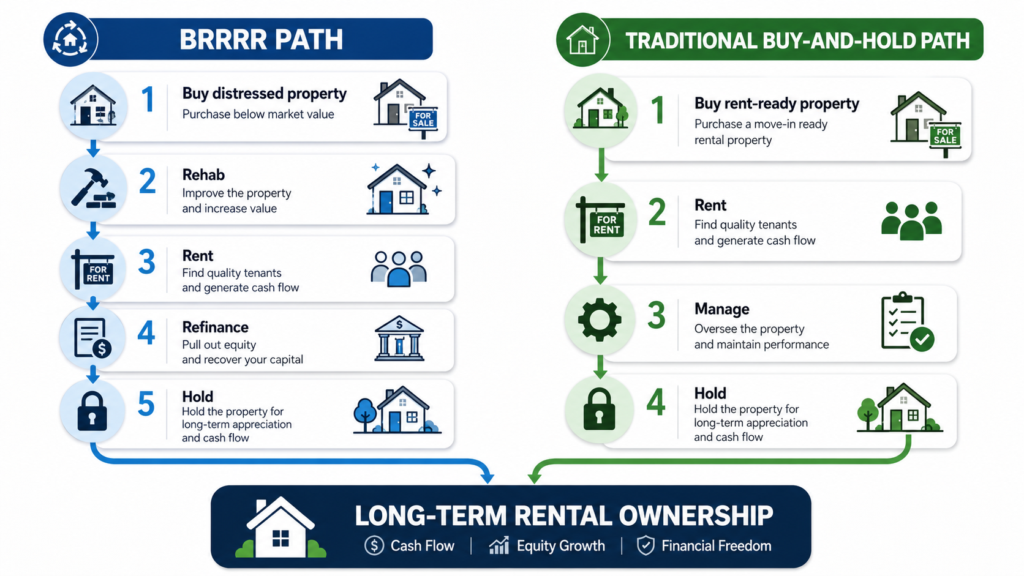
The simplest distinction is this:
Traditional buy and hold usually acquires an existing rental asset. BRRRR attempts to create a stabilized rental asset.
A rent-ready buy-and-hold property may begin producing income shortly after closing. You normally invest more equity at acquisition but take less construction and refinancing risk.
A BRRRR property may require months of work before it produces rental income. You accept more operational and financing risk in exchange for the possibility of creating equity and recovering part of your invested capital.
Both approaches eventually reach the same general destination: ownership of an income-producing rental property.
They take different routes to get there.
BRRRR vs. Buy and Hold at a Glance
| Comparison | BRRRR | Traditional buy and hold |
|---|---|---|
| Property condition | Usually distressed or in need of substantial work | Usually rent-ready or needs minor repairs |
| Initial financing | Often cash, hard money, private money, or bridge financing | Often long-term investment-property financing |
| Rehabilitation | Central part of the strategy | Usually limited or completed gradually |
| Time before rent | Longer due to renovation and lease-up | Usually shorter |
| Initial workload | High | Low to moderate |
| Construction risk | Significant | Limited |
| Refinance risk | Central to the plan | Usually optional |
| Equity creation | Primarily through acquisition and rehabilitation | Primarily through down payment, amortization, and appreciation |
| Capital recovery | May recover capital through refinancing | Capital usually remains invested unless refinanced or sold |
| Cash needed at closing | May be lower, but reserves can be substantial | Often higher because of the down payment |
| Predictability | Lower during stabilization | Generally higher at acquisition |
| Scaling potential | Can recycle capital more quickly | Often limited by savings and borrowing capacity |
| Best suited for | Active investors with renovation and financing capabilities | Investors seeking a simpler acquisition and stable operation |
This table describes common patterns rather than universal rules. You can purchase a distressed property with conventional financing, renovate a buy-and-hold property over time, or retain all your capital in a BRRRR property.
The difference is the intended investment process.
What Is Traditional Buy-and-Hold Real Estate?
Traditional buy and hold generally means purchasing a property with the intention of operating it as a long-term rental.
The property may already be occupied, recently renovated, or ready to lease after minor repairs. You commonly use long-term financing at acquisition and begin operating the property without a major construction phase.
Your potential returns may come from:
- Rental cash flow
- Mortgage principal reduction
- Property appreciation
- Rent growth
- Tax treatment available to rental-property owners
- A future sale or exchange
The approach is simple in concept, but it still requires careful analysis. A rent-ready property can have excessive taxes, weak rent, deferred maintenance, poor tenants, expensive insurance, or an unfavorable purchase price.
“Rent-ready” does not mean “low-risk.”
A Typical Buy-and-Hold Process
A traditional acquisition may follow this sequence:
- Identify a property that is already rentable.
- Estimate achievable rent and operating expenses.
- Inspect the property and review its condition.
- Obtain long-term financing.
- Close with a down payment and reserves.
- Complete minor repairs or turnover work.
- Lease and manage the property.
- Hold it for income and long-term value.
You generally know the purchase price, permanent loan, expected rent, and approximate operating expenses before closing.
That relative predictability is one of the strategy’s main advantages.
What Is the BRRRR Method?
BRRRR stands for:
- Buy
- Rehab
- Rent
- Refinance
- Repeat
You normally acquire a property below its expected stabilized value because it has physical, financial, or operational problems.
You then rehabilitate it, place it into rental service, and attempt to refinance based on its completed condition and value. The refinance pays off the acquisition or construction financing and may return part of your original cash.
A typical BRRRR process looks like this:
- Purchase a distressed or underperforming property.
- Complete a planned rehabilitation.
- Establish a tenant and rental income.
- Obtain a new appraisal.
- Replace short-term debt with long-term financing.
- Recover some or all invested capital when possible.
- Hold the property as a rental.
- Use available capital for another investment.
The method creates additional opportunities, but every added stage introduces another point of failure.
BRRRR Is More Than Buying a Fixer-Upper
A property does not become a BRRRR deal merely because you renovate it.
For the strategy to work as intended, the completed property must:
- Be worth materially more than the total project cost
- Produce enough rent to support operating expenses and permanent debt
- Qualify for an appropriate refinance
- Leave you with a satisfactory amount of capital invested
- Remain viable as a long-term rental
You can complete a successful renovation and still have an unsuccessful BRRRR deal.
For example, the property may look better and rent successfully, but the appraisal may be too low to repay the short-term loan. Alternatively, the appraisal may be strong while the rent is too low to support the desired permanent mortgage.
The renovation, appraisal, rent, and financing must work together.
How the Acquisition Process Differs
The first major difference appears before you purchase the property.
Traditional Buy-and-Hold Acquisition
A traditional investor often emphasizes:
- Current condition
- Existing or immediately achievable rent
- In-place operating expenses
- Long-term loan terms
- Inspection results
- Neighborhood stability
- Expected cash flow after closing
The property’s current performance is usually more important than its potential after a major transformation.
You may still negotiate a discount, but the deal does not necessarily depend on creating substantial new value.
BRRRR Acquisition
A BRRRR investor must analyze both the property as it exists and the property it could become.
You need to estimate:
- Purchase price
- Acquisition costs
- Rehabilitation scope
- Contractor pricing
- Holding period
- Short-term financing cost
- After-repair value
- Stabilized rent
- Permanent financing
- Refinance expenses
- Capital remaining after refinancing
You are effectively underwriting two properties:
- The distressed property you are buying
- The stabilized rental you intend to create
Errors in either analysis can weaken the project.
Property Condition and Rehabilitation Risk
Traditional buy and hold generally exposes you to less immediate construction risk.
A rent-ready property may still need repairs, but you may be able to complete them between tenants or fund them gradually from reserves and operating income.
BRRRR normally concentrates a large amount of construction into a short period.
Common BRRRR Rehabilitation Risks
These include:
- Incomplete inspections
- Hidden structural damage
- Plumbing or electrical problems
- Water intrusion
- Mold or environmental hazards
- Permit delays
- Contractor disputes
- Material-price changes
- Incorrect measurements or scopes
- Failed inspections
- Theft or vandalism
- Loan-draw delays
- Work that does not create equivalent value
A $50,000 rehabilitation does not automatically create $50,000 of additional market value.
The work must be appropriate for the property and supported by the market.
Buy and Hold Can Still Contain Deferred Maintenance
You should not assume that a renovated or occupied property has no repair risk.
A cosmetic renovation can conceal:
- Old mechanical systems
- Aging roofs
- Drainage problems
- Poor-quality workmanship
- Unpermitted alterations
- Short remaining useful lives
- Maintenance deferred by the seller
Traditional buy and hold reduces the size of the planned construction phase. It does not eliminate due diligence or future capital expenditures.
Financing Differences
Financing is one of the most important distinctions between the strategies.
Buy-and-Hold Financing
A traditional rental acquisition may use:
- A conventional investment-property mortgage
- A portfolio loan
- A commercial loan
- A DSCR loan
- Seller financing
- Private financing
The original loan may remain in place for years.
You normally know your long-term interest rate, payment, amortization, and loan amount before closing. Unless you later choose to refinance, you avoid a second mandatory financing event.
BRRRR Financing
BRRRR may require two separate loans:
- Short-term acquisition and rehab financing
- Long-term rental-property financing
Short-term financing may have:
- Higher interest
- Origination points
- Draw procedures
- Inspection requirements
- Short maturities
- Extension charges
- Minimum interest provisions
- Personal guarantees
- Construction controls
The permanent refinance introduces another underwriting process after you already own the property and have spent money on the project.
Your lender may evaluate:
- Credit
- Income
- Debt-to-income ratio
- Debt service coverage
- Property value
- Lease terms
- Market rent
- Ownership seasoning
- Cash-out seasoning
- Reserves
- Property type and condition
The refinance is not guaranteed merely because the rehabilitation is complete.
Initial Cash Requirements
BRRRR is often promoted as a low-cash strategy. That description can be misleading.
You may contribute less cash toward the purchase price, but you may need substantial liquidity throughout the project.
Buy-and-Hold Cash Requirements
Your cash requirement may include:
- Down payment
- Buyer closing costs
- Initial repairs
- Leasing costs
- Operating reserves
- Lender-required reserves
A lender may require a larger down payment because the property is an investment rather than an owner-occupied residence.
Once the property closes and begins producing income, your major acquisition expense is complete.
BRRRR Cash Requirements
Your cash requirement may include:
- Down payment or equity contribution
- Acquisition closing costs
- Loan fees and points
- Contractor deposits
- Rehab costs before draw reimbursement
- Interest during construction
- Taxes
- Insurance
- Utilities
- Permits
- Inspections
- Cost overruns
- Lease-up costs
- Refinance costs
- Cash required because of a low appraisal
You may start with less cash at closing and still need more accessible capital during the project.
A BRRRR deal is not safely funded if you can close but cannot absorb delays or overruns.
How Equity Is Created
Both strategies can build equity, but they usually do so differently.
Buy-and-Hold Equity
Traditional buy-and-hold equity may come from:
- Your initial down payment
- Mortgage principal reduction
- Market appreciation
- Minor value-enhancing improvements
- Rent growth that increases an income-based valuation
You often begin with equity because you made a meaningful down payment.
However, part of that equity is simply your own cash converted into property ownership.
BRRRR Equity
BRRRR equity may come from:
- Purchasing below stabilized value
- Correcting physical problems
- Improving the property’s condition
- Increasing legal or functional utility
- Converting a vacant property into an occupied rental
- Improving income in a small multifamily property
- Completing work that comparable buyers value
This is sometimes called forced appreciation, although the phrase should be used carefully.
You can influence value through acquisition and improvement, but the market and appraiser ultimately determine whether that value is recognized.
Capital Recovery and Reuse
The refinance creates BRRRR’s primary capital-efficiency advantage.
Suppose you invest $40,000 in a project and the refinance returns $25,000. You now have:
- $15,000 remaining in the property
- A stabilized rental
- Long-term debt
- $25,000 available for reserves, debt reduction, or another investment
With a traditional buy-and-hold purchase, your down payment usually remains tied to the property unless you sell or refinance.
That does not mean BRRRR creates free capital.
The recovered cash comes from new debt secured by the property. Increasing refinance proceeds also increases leverage and debt service.
More Capital Recovery Is Not Always Better
A larger refinance may:
- Return more cash
- Increase the monthly mortgage payment
- Reduce cash flow
- Lower debt-service coverage
- Reduce equity
- Increase sensitivity to vacancy and repairs
You should balance capital recovery against the stability of the completed rental.
The best refinance is not necessarily the largest available loan.
Time Before the Property Produces Income
A rent-ready buy-and-hold property may begin producing rent immediately or after a brief turnover.
A BRRRR property may remain vacant throughout:
- Acquisition
- Design and estimating
- Permitting
- Construction
- Inspection
- Appraisal
- Leasing
- Refinancing
During that period, you may be paying interest, taxes, insurance, utilities, lawn service, security, and other holding expenses.
The Cost of Delay
Suppose your property has $2,000 of monthly financing and holding expenses.
A three-month delay adds approximately:
$2,000 × 3 months = $6,000
That added cost may not increase the property’s value or rent.
Traditional buy and hold can also experience vacancy and turnover. The difference is that extended non-income periods are often built into the BRRRR process from the beginning.
Comparing Cash Flow
It is easy to assume BRRRR produces better cash flow because the property was purchased at a discount.
That may be true, but it depends on the permanent loan.
BRRRR Cash Flow
A well-executed BRRRR project may have:
- A lower total cost than stabilized market value
- A permanent loan below the amount needed to purchase the property rent-ready
- Newly completed major systems
- Reduced near-term repair needs
It may also have:
- A high refinance balance
- Expensive permanent financing
- Higher taxes after reassessment
- Increased insurance costs
- Minimal remaining reserves
Buy-and-Hold Cash Flow
A traditional property may have:
- A larger acquisition mortgage
- Less immediate equity creation
- Older building components
- A lower cash-on-cash return because of the down payment
It may also offer:
- Immediate rent
- Predictable debt service
- Fewer financing fees
- No construction interest
- Less operational disruption
- Lower execution risk
You need to compare the completed properties after all financing and operating expenses—not compare the BRRRR purchase price with the rent-ready property’s purchase price.
BRRRR vs. Buy and Hold Example With Numbers
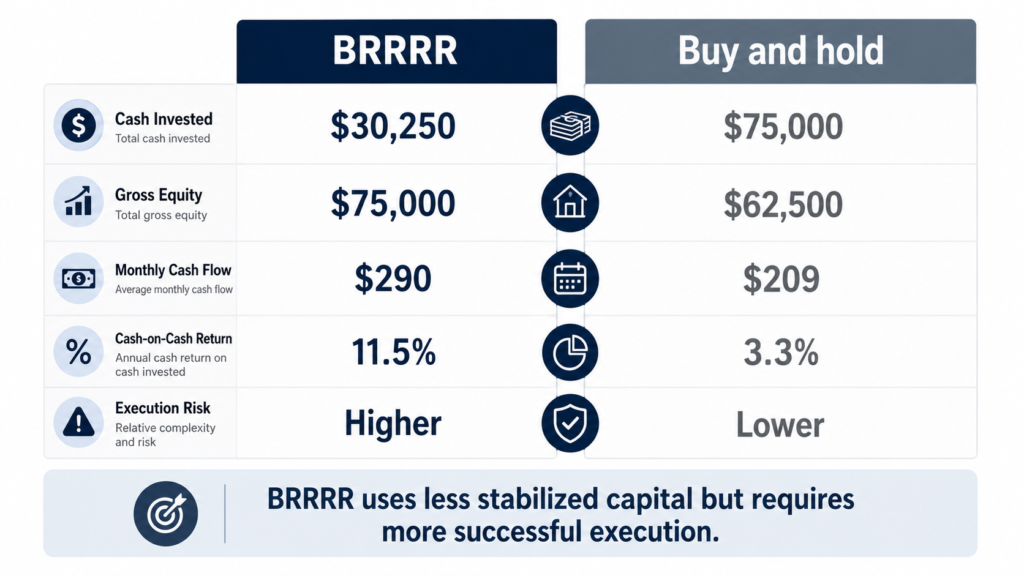
Consider two hypothetical ways to acquire an equivalent rental property.
In both scenarios, the completed property is worth $250,000, rents for $2,500 per month, and produces approximately $1,425 per month before mortgage payments after allowances for vacancy, management, maintenance, taxes, insurance, and capital reserves.
The financing assumptions are illustrative and not quotations from a lender.
Traditional Buy-and-Hold Example
You purchase a rent-ready property for $250,000.
| Buy-and-hold item | Amount |
| Purchase price | $250,000 |
| Down payment, 25% | $62,500 |
| Acquisition closing costs | $6,500 |
| Initial repair and operating reserve | $6,000 |
| Total cash invested | $75,000 |
| Long-term mortgage | $187,500 |
Assume the $187,500 mortgage has a 30-year amortization period and a 6.75% fixed interest rate.
The estimated principal-and-interest payment is approximately $1,216 per month.
Projected monthly cash flow is:
$1,425 − $1,216 = $209
Projected annual cash flow is:
$209 × 12 = $2,508
Projected cash-on-cash return is:
$2,508 ÷ $75,000 = 3.3%
Gross equity immediately after closing is approximately:
$250,000 value − $187,500 mortgage = $62,500
That equity primarily represents your down payment.
BRRRR Example
You purchase a distressed version of an equivalent property for $140,000.
| BRRRR project item | Amount |
| Purchase price | $140,000 |
| Acquisition closing costs | $4,000 |
| Rehabilitation | $45,000 |
| Financing and holding costs | $11,000 |
| Total project cost | $200,000 |
| After-repair value | $250,000 |
Assume the short-term lender finances 90% of the purchase price and the full $45,000 rehabilitation budget.
| Initial funding item | Amount |
| Purchase financing | $126,000 |
| Rehab financing | $45,000 |
| Total short-term principal | $171,000 |
| Initial cash contribution | $29,000 |
After the property is completed and rented, you refinance at 70% of its $250,000 appraised value:
$250,000 × 70% = $175,000
Assume refinance costs equal 3% of the new loan:
$175,000 × 3% = $5,250
The refinance calculation is:
| Refinance item | Amount |
| New permanent loan | $175,000 |
| Short-term principal payoff | −$171,000 |
| Refinance costs | −$5,250 |
| Additional cash required at closing | $1,250 |
You initially contributed $29,000 and bring another $1,250 to the refinance. Your total capital remaining in the property is approximately:
$29,000 + $1,250 = $30,250
Assume the new $175,000 mortgage also has a 30-year amortization period and a 6.75% fixed interest rate.
The estimated principal-and-interest payment is approximately $1,135 per month.
Projected monthly cash flow is:
$1,425 − $1,135 = $290
Projected annual cash flow is:
$290 × 12 = $3,480
Projected cash-on-cash return is:
$3,480 ÷ $30,250 = 11.5%
Gross equity after refinancing is:
$250,000 value − $175,000 mortgage = $75,000
Comparing the Two Examples
| Result | BRRRR | Buy and hold |
| Stabilized property value | $250,000 | $250,000 |
| Total cash remaining or invested | $30,250 | $75,000 |
| Permanent mortgage | $175,000 | $187,500 |
| Gross equity | $75,000 | $62,500 |
| Estimated monthly cash flow | $290 | $209 |
| Estimated annual cash flow | $3,480 | $2,508 |
| Estimated cash-on-cash return | 11.5% | 3.3% |
| Major rehab required | Yes | No |
| Mandatory refinance | Yes | No |
| Time before stabilization | Longer | Shorter |
| Execution risk | Higher | Lower |
The BRRRR result appears financially stronger because the investor creates a $250,000 stabilized property for a total project cost of $200,000.
However, that outcome depends on several assumptions being correct:
- The rehabilitation stays at $45,000.
- The property is completed on schedule.
- The $250,000 appraisal is achieved.
- The short-term lender funds as expected.
- The permanent lender approves the refinance.
- The property rents for $2,500.
- No serious defect is discovered.
- Financing terms remain acceptable.
The traditional investor contributes more cash but avoids most of those project-stage risks.
A Cost Overrun Changes the Comparison
If the BRRRR rehabilitation costs $15,000 more than expected, the investor’s remaining capital increases from $30,250 to $45,250.
Assuming cash flow remains $3,480 per year, cash-on-cash return becomes:
$3,480 ÷ $45,250 = 7.7%
The BRRRR example may still outperform the traditional acquisition on that measure, but the advantage narrows.
A lower appraisal, longer schedule, lower rent, or more expensive refinance could narrow it further.
Comparing acquisition strategies or multiple project scenarios? Rehab Valuator provides advanced deal analysis, rehab budgeting, financing comparisons, and investor and lender reporting when you need to examine a renovation and refinance in greater detail.
Which Strategy Produces the Better Return?
The answer depends on how you measure return.
Possible measures include:
- Monthly cash flow
- Annual cash flow
- Cash-on-cash return
- Equity created
- Return on total project cost
- Debt-service coverage
- Internal rate of return
- Time invested
- Risk-adjusted return
- Total return after sale
BRRRR often produces a higher cash-on-cash return because less investor capital remains in the stabilized property.
That does not automatically mean it creates a better risk-adjusted return.
The Denominator Effect
Cash-on-cash return divides annual cash flow by invested cash.
When a refinance returns most of your capital, the denominator becomes small. That can create an extremely high percentage even when actual monthly cash flow is modest.
For example:
$2,400 annual cash flow ÷ $5,000 remaining capital = 48%
A 48% cash-on-cash return appears exceptional. But the property may have:
- High leverage
- Thin debt coverage
- Minimal reserves
- Significant deferred maintenance
- A variable-rate loan
- A prepayment penalty
- Concentrated market risk
The percentage should be evaluated alongside the property’s debt, equity, condition, and operating margin.
Workload and Required Skills
BRRRR normally requires more active involvement before stabilization.
You may need to manage:
- Acquisition negotiations
- Construction estimates
- Contractor selection
- Permits
- Draw requests
- Inspections
- Material decisions
- Budget controls
- Leasing
- Appraisal preparation
- Refinance documentation
Traditional buy and hold may reduce the project-management burden, but long-term ownership still requires:
- Tenant screening
- Lease administration
- Rent collection
- Maintenance
- Accounting
- Inspections
- Legal compliance
- Vendor management
- Turnover planning
Both approaches make you a housing provider.
Federal fair-housing protections apply broadly to rental housing, and your state or local laws may impose additional requirements. HUD provides an overview of housing discrimination protections under the Fair Housing Act.
You can hire contractors, agents, lenders, and property managers, but you remain responsible for selecting and supervising the professionals involved in your investment.
Scalability
BRRRR is often chosen because recovered capital can be used again.
How BRRRR Can Accelerate Growth
Suppose you have $100,000 available.
If each traditional buy-and-hold property requires $50,000, you may be able to acquire two properties before needing additional savings or equity.
If each BRRRR project ultimately leaves $20,000 invested, the same capital may support more properties over time.
That advantage depends on your ability to:
- Find suitable deals
- Complete renovations
- Qualify for refinancing
- Maintain borrowing capacity
- Preserve reserves
- Manage an expanding portfolio
Scaling faster can magnify mistakes as well as returns.
Traditional Buy and Hold May Scale More Slowly
Traditional acquisitions may require repeated down payments.
Portfolio growth may depend on:
- Ongoing savings
- Retained rental income
- Partnerships
- New equity
- Future refinancing
- Property sales
The process may be slower, but it can be easier to manage because you are not operating several simultaneous construction and refinance projects.
The fastest possible growth rate is not necessarily the safest or most sustainable one.
Risk Comparison
Each strategy concentrates risk in different areas.
BRRRR Risks
BRRRR has greater exposure to:
- Incorrect rehab estimates
- Contractor performance
- Permit and inspection delays
- Short-term debt maturity
- Draw procedures
- Low appraisals
- Refinance qualification
- Interest-rate changes
- Lease-up delays
- Capital shortages
Traditional Buy-and-Hold Risks
Traditional buy and hold has greater exposure to:
- Paying full market value
- Lower initial equity growth
- Larger cash requirements
- Existing tenant problems
- Deferred maintenance hidden by occupancy
- Lower capital efficiency
- Dependence on gradual appreciation and amortization
Risks Shared by Both
Both approaches remain exposed to:
- Vacancy
- Nonpayment
- Repairs
- Property taxes
- Insurance
- Regulatory changes
- Fair-housing obligations
- Market decline
- Natural disasters
- Poor management
- Concentration in one property or market
The absence of a major renovation does not make a traditional rental passive or risk-free.
When BRRRR May Be the Better Choice
BRRRR may suit you when:
- You can acquire materially below stabilized value.
- You understand renovation costs and timelines.
- You have reliable contractors.
- Comparable sales support the expected ARV.
- Local rents support permanent financing.
- You have access to appropriate short-term and long-term loans.
- You can fund draws, overruns, and delays.
- You want to create equity rather than wait primarily for appreciation.
- You are willing to manage a more complex project.
- You can leave additional money invested if the refinance is smaller than expected.
BRRRR works best when the opportunity comes from a solvable property problem.
The strategy is less compelling when the property is discounted because of an uncorrectable location, severe market weakness, excessive environmental risk, or another problem that remains after renovation.
When Traditional Buy and Hold May Be the Better Choice
Traditional buy and hold may suit you when:
- You want rental income quickly.
- You prefer predictable long-term financing.
- You lack construction experience.
- You have limited time for project management.
- You are investing from a distance.
- You have sufficient capital for the down payment.
- You prioritize stability over rapid capital recycling.
- Rent-ready properties produce acceptable returns in your market.
- You want to avoid refinance dependency.
- You are building your first rental-property operating systems.
A lower expected return may be reasonable when the investment requires less execution and presents fewer opportunities for a large loss.
Is BRRRR Better for Beginners?
Not necessarily.
BRRRR requires you to perform several tasks correctly before the property reaches stable operation.
A beginner must coordinate:
- Deal analysis
- Property inspection
- Rehabilitation planning
- Contractor management
- Financing
- Appraisal
- Tenant placement
- Refinancing
- Property management
A traditional rental allows you to learn leasing, accounting, maintenance, and management without simultaneously managing a large renovation.
That does not mean a beginner cannot complete a BRRRR project.
A first-time BRRRR investor may reduce risk by selecting:
- A straightforward single-family property
- A conventional layout
- A mostly cosmetic rehabilitation
- Strong comparable sales
- Established rental demand
- A conservative loan
- An experienced contractor
- A wide contingency
- More liquidity than the base budget requires
Your first investment does not need to maximize leverage or return.
Can You Combine BRRRR and Traditional Buy and Hold?
Yes. A portfolio does not need to follow one strategy exclusively.
You might use BRRRR when you find a strong value-add opportunity and purchase rent-ready properties when the numbers are attractive without major renovation.
You may also use a hybrid strategy.
Light BRRRR
You purchase a property that needs moderate improvements rather than a complete rehabilitation.
You may:
- Use long-term financing at acquisition
- Complete renovations while vacant or occupied
- Increase rent
- Refinance later if appropriate
- Retain the property without depending on capital recovery
This approach can reduce short-term financing and construction risk.
Buy, Improve, and Hold Without Refinancing
You may buy below market, renovate, and keep the original financing.
You still create value, but you do not complete the refinance stage.
This may be appropriate when:
- The original loan is favorable
- Refinance costs are too high
- A new loan would reduce cash flow
- You do not need the capital immediately
- The refinance would create excessive leverage
You should use the financing structure that supports the property rather than force every project into the full acronym.
Tax and Recordkeeping Considerations
Both strategies create rental-income, expense, depreciation, and recordkeeping issues.
The IRS’s residential rental property guidance discusses rental income, expenses, depreciation, passive-activity rules, and related reporting considerations.
BRRRR projects can create additional accounting complexity because you must distinguish among:
- Acquisition costs
- Financing expenses
- Repairs
- Capital improvements
- Holding costs
- Property placed-in-service dates
- Depreciable building costs
- Nondepreciable land
- Refinance proceeds and loan costs
The IRS explains that basis is generally your investment in the property for tax purposes and that qualifying improvements can increase adjusted basis. Accurate records are needed to calculate depreciation and future gain or loss. Review the IRS guidance on basis and adjustments to basis and consult a qualified tax professional about your circumstances.
Your project budget and your tax basis are not necessarily the same number.
Questions to Ask Before Choosing a Strategy
Questions About Your Capital
- How much cash can you invest without exhausting your reserves?
- Can you fund rehab draws before reimbursement?
- Can you absorb a lower appraisal?
- How long can you carry a vacant property?
- Do you need to recover capital quickly?
Questions About Your Experience
- Can you estimate repairs accurately?
- Have you managed contractors?
- Do you understand permits and inspections?
- Can you evaluate comparable sales and rents?
- Can you coordinate two financing transactions?
Questions About the Property
- Is the property already rentable?
- What problem creates the purchase discount?
- Can that problem be corrected economically?
- Is the expected ARV supported?
- Will the completed rent support the refinance?
Questions About Your Objectives
- Are you prioritizing income, equity, or growth?
- Do you want a simpler investment or a value-add project?
- How much time can you dedicate?
- How quickly do you want to expand?
- Would you still want the property if the refinance returned no cash?
Your answers may point clearly toward one strategy.
BRRRR vs. Buy and Hold: Which Is Better?
BRRRR may provide greater capital efficiency, stronger equity creation, and faster portfolio growth when you acquire and rehabilitate the right property.
Traditional buy and hold may provide greater predictability, faster rental income, simpler financing, and lower execution risk.
The correct comparison is not:
- High return versus low return
- Active investing versus passive investing
- Good strategy versus outdated strategy
The correct comparison is:
- More complexity and value-creation potential
- Versus greater simplicity and predictability
A strong BRRRR deal can outperform a rent-ready acquisition because you create a stabilized property for less than its completed value.
A strong traditional buy-and-hold property can outperform a poorly executed BRRRR because it avoids overruns, financing problems, appraisal risk, and extended vacancy.
Evaluate the actual property, not the label attached to the strategy.
Final Perspective
BRRRR and traditional buy and hold ultimately serve the same broad objective: owning rental real estate that produces an acceptable long-term return.
BRRRR emphasizes value creation and capital recycling. Traditional buy and hold emphasizes immediate operation and financing stability.
You may prefer BRRRR when you have the experience, team, financing, reserves, and opportunity to solve a property problem profitably.
You may prefer traditional buy and hold when you value predictable debt, quicker rental income, reduced construction exposure, and a simpler acquisition.
You do not need to choose one method for your entire investing career.
The better strategy is the one that fits the property, your resources, and your ability to execute without relying on optimistic assumptions.