BRRRR LTV Explained

Loan-to-value ratio, commonly abbreviated as LTV, compares a real estate loan with the value of the property securing it.
In a BRRRR project, LTV affects how much a lender may provide for the initial acquisition, how much permanent financing may be available after renovation, how much equity remains in the property, and how much of your original capital you may recover.
A higher LTV can return more cash during refinancing, but it also creates a larger mortgage payment and leaves less equity in the property.
A lower LTV generally preserves more equity and reduces debt service, but it may require you to leave substantially more cash invested.
Neither outcome is automatically better.
The appropriate LTV depends on the property’s rent, operating expenses, appraisal, financing costs, required reserves, and your long-term risk tolerance.
What Is Loan-to-Value Ratio?
The basic formula is:
LTV = Loan amount ÷ Property value
To express the result as a percentage, multiply by 100.
Assume:
- Loan amount: $175,000
- Property value: $250,000
The calculation is:
$175,000 ÷ $250,000 = 0.70
0.70 × 100 = 70% LTV
The loan represents 70% of the property’s value.
The remaining 30% is the property owner’s gross equity before considering selling costs or other liens.
The Consumer Financial Protection Bureau describes loan-to-value ratio as a comparison between the amount financed and the property’s appraised value. Lenders may use LTV when determining loan eligibility, pricing, and other terms.
BRRRR Loan-to-Value Calculator
Enter the loan amount and property value to calculate the loan-to-value ratio and estimated gross equity.
This calculation shows the loan amount as a percentage of property value. It does not include subordinate liens, refinance costs, lender seasoning rules, cost-basis limits, or debt-service requirements.
Why LTV Matters in a BRRRR Deal
LTV affects several stages of the BRRRR process.
Acquisition Financing
A short-term lender may limit the purchase loan based on:
- Purchase price
- As-is appraised value
- After-repair value
- Total eligible project cost
The lender may use more than one limitation and approve the lowest resulting loan amount.
Rehabilitation Financing
The total acquisition and rehab commitment may be capped at a percentage of the projected ARV.
A lender might agree to fund the full rehabilitation budget while still limiting the combined loan to a maximum ARV-based LTV.
Permanent Refinance
The refinance lender may multiply the completed appraised value by the maximum permitted LTV.
That calculation establishes a gross loan ceiling before considering:
- Debt-service coverage
- Borrower qualifications
- Cost-basis restrictions
- Seasoning
- Existing debt
- Closing costs
- Program loan limits
Capital Recovery
The refinance loan must first repay the acquisition or rehab debt.
Only the remaining proceeds, after debt payoff and transaction expenses, can return capital to you.
Long-Term Risk
A larger permanent loan produces:
- Higher debt service
- Less equity
- Lower protection from declining values
- Greater sensitivity to vacancy and expenses
- Potentially more capital available for another investment
LTV is therefore both a financing measurement and a risk-management decision.
Purchase LTV and Refinance LTV Are Calculated Differently
For a purchase transaction, lenders may use the lower of the contract price or appraised value.
For a refinance transaction, the calculation commonly uses the current appraised value, subject to the lender’s program requirements.
Fannie Mae’s LTV calculation guidance illustrates this distinction.
Purchase Example
Assume:
- Contract price: $160,000
- Appraised value: $170,000
- Loan: $128,000
The purchase value used for the LTV calculation may be the lower $160,000 contract price.
$128,000 ÷ $160,000 = 80% LTV
The higher appraisal does not necessarily permit the lender to treat the transaction as 75.3% LTV.
Low-Appraisal Purchase Example
Assume:
- Contract price: $160,000
- Appraised value: $150,000
- Proposed loan: $128,000
The lender may calculate:
$128,000 ÷ $150,000 = 85.3% LTV
The lower appraisal increases the LTV even though the purchase price and loan request did not change.
The lender may reduce the loan, require additional cash, change the terms, or decline the transaction.
Refinance Example
Assume the renovated property appraises for $260,000 and the new loan is $182,000.
$182,000 ÷ $260,000 = 70% LTV
The original purchase price may still matter for seasoning or cost-basis requirements, but it is not necessarily the denominator used in the basic refinance LTV calculation.
The Different LTV Measurements in a BRRRR Project
A BRRRR deal may involve several loan-to-value measurements.
As-Is LTV
As-is LTV compares the acquisition loan with the property’s current value before rehabilitation.
Assume:
- As-is value: $150,000
- Purchase loan: $112,500
$112,500 ÷ $150,000 = 75% as-is LTV
This tells the lender how much exposure it has against the property in its present condition.
Purchase-Price LTV
Purchase-price LTV compares the loan with the contract price.
Assume:
- Purchase price: $140,000
- Purchase loan: $112,000
$112,000 ÷ $140,000 = 80% purchase-price LTV
This indicates that the borrower contributes 20% of the purchase price before closing costs and other expenses.
ARV LTV
ARV LTV compares the total acquisition and rehab loan commitment with the expected after-repair value.
Assume:
- Total loan commitment: $180,000
- ARV: $270,000
$180,000 ÷ $270,000 = 66.7% ARV LTV
A short-term lender may use this calculation to limit total exposure after the full rehab budget is advanced.
Refinance LTV
Refinance LTV compares the new permanent loan with the completed property value.
Assume:
- Permanent loan: $189,000
- Completed value: $270,000
$189,000 ÷ $270,000 = 70% refinance LTV
This is usually the LTV that most directly affects BRRRR capital recovery and long-term debt service.
LTV Is Not the Same as LTC
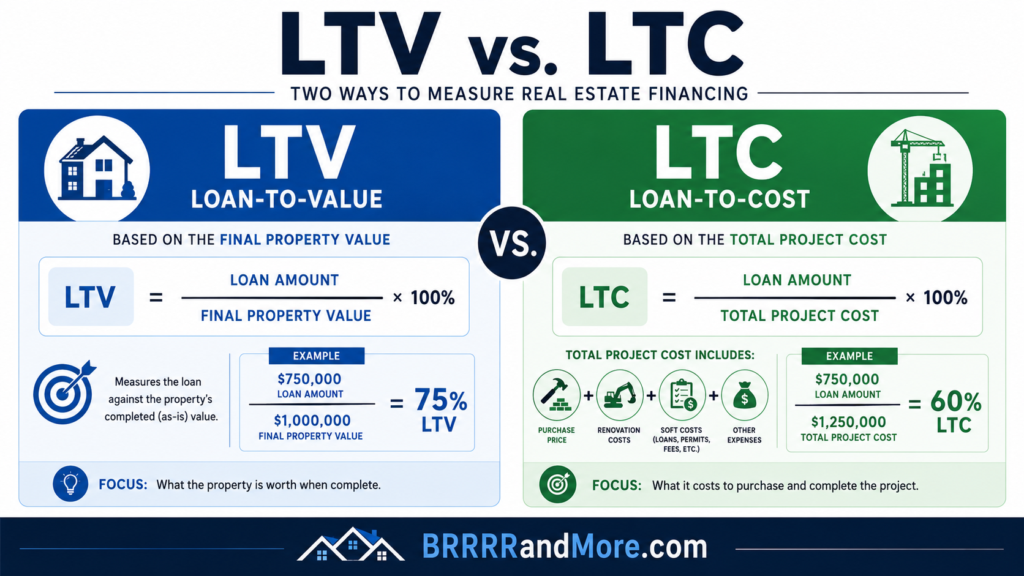
Loan-to-cost ratio, or LTC, compares the loan with the eligible project cost rather than the property value.
The formula is:
LTC = Loan amount ÷ Project cost
Assume:
- Loan amount: $180,000
- Eligible purchase and rehab cost: $225,000
$180,000 ÷ $225,000 = 80% LTC
The same loan may have:
- 80% LTC
- 66.7% ARV LTV
These are not conflicting figures. They measure different relationships.
Why Both Measures Matter
LTV protects the lender relative to the property’s value.
LTC determines how much of the project cost the lender funds and how much capital the borrower must contribute.
A deal can have a conservative ARV LTV while requiring very little borrower cash if the purchase price and rehab cost are low relative to the completed value.
A deal can also have a moderate LTC while producing a high LTV if the value margin is thin.
Your complete BRRRR financing analysis should identify both measurements when they apply.
LTV Is Not the Same as the 70 Percent Rule
The 70 percent rule is an acquisition-screening formula:
ARV × 70% − Repairs = Preliminary maximum offer
LTV is a lending ratio:
Loan amount ÷ Property value = LTV
The numbers may both use 70%, but they answer different questions.
The 70 percent rule estimates a possible purchase-price ceiling.
A 70% refinance LTV estimates a possible permanent loan amount.
A property can satisfy the BRRRR 70 percent rule while qualifying for a refinance above or below 70% LTV.
LTV, CLTV, and HCLTV
LTV generally measures the first mortgage relative to property value.
When additional liens exist, lenders may also calculate combined ratios.
Combined Loan-to-Value
Combined loan-to-value, or CLTV, generally includes the balances of the first mortgage and closed-end subordinate loans.
The basic formula is:
CLTV = Total mortgage balances ÷ Property value
Assume:
- First mortgage: $175,000
- Second mortgage: $20,000
- Property value: $250,000
($175,000 + $20,000) ÷ $250,000 = 78% CLTV
The first-mortgage LTV is 70%, but the combined leverage is 78%.
HELOC Combined Loan-to-Value
When a home equity line is involved, the lender may calculate another ratio using the full available line rather than only the amount currently drawn.
That calculation may be called HCLTV or, under some lender terminology, a total LTV measurement.
These combined ratios matter when another lien remains on the property after refinancing.
How Acquisition Lenders Use LTV
Hard money and bridge lenders may apply several simultaneous limits.
Assume:
| Project item | Amount |
|---|---|
| Purchase price | $140,000 |
| As-is value | $150,000 |
| Rehab budget | $50,000 |
| ARV | $260,000 |
The lender offers:
- Up to 90% of purchase price
- Up to 75% of as-is value
- Up to 70% of ARV
- Up to 100% of approved rehab costs
Purchase-Price Limit
$140,000 × 90% = $126,000
As-Is Value Limit
$150,000 × 75% = $112,500
ARV Limit
$260,000 × 70% = $182,000
If the lender applies the lower of the purchase-price and as-is limits, the initial purchase advance may be limited to $112,500.
Adding the $50,000 rehab facility creates a total commitment of:
$112,500 + $50,000 = $162,500
That amount remains below the $182,000 ARV cap.
The lender’s final commitment may therefore be $162,500.
This example shows why an advertised “90% purchase financing” offer does not necessarily mean you will receive 90% of the contract price.
Another LTV limit may control the result.
How Permanent Lenders Use LTV
The completed appraisal and the permitted LTV establish a potential maximum loan.
Assume:
- Completed appraisal: $260,000
| Refinance LTV | Gross loan amount |
| 60% | $156,000 |
| 65% | $169,000 |
| 70% | $182,000 |
| 75% | $195,000 |
| 80% | $208,000 |
Every five-percentage-point increase changes the gross loan by:
$260,000 × 5% = $13,000
That difference can materially affect the amount of cash returned to you.
The calculation is only a ceiling.
The actual loan may be lower because of:
- DSCR
- Income documentation
- Credit
- Reserves
- Property type
- Seasoning
- Cost-basis rules
- Loan minimum or maximum
- Existing liens
- Insurance
- Appraisal review
Worked BRRRR LTV Example
Assume the following project:
| Project assumption | Amount |
| Purchase price | $135,000 |
| Rehabilitation | $50,000 |
| Acquisition and holding costs | $15,000 |
| Total project cost | $200,000 |
| Completed appraised value | $260,000 |
| Short-term principal balance | $171,500 |
| Investor cash contributed | $28,500 |
The short-term principal consists of:
- 90% of the $135,000 purchase price: $121,500
- Rehab financing: $50,000
Total:
$121,500 + $50,000 = $171,500
Assume refinance costs equal 3% of the new permanent loan.
Refinance at 65% LTV
Gross loan:
$260,000 × 65% = $169,000
Refinance costs:
$169,000 × 3% = $5,070
Cash required after loan payoff:
$169,000 − $171,500 − $5,070 = −$7,570
You would need to bring approximately $7,570 to the refinance closing.
Total capital remaining becomes:
$28,500 + $7,570 = $36,070
Gross equity after refinancing is:
$260,000 − $169,000 = $91,000
Refinance at 70% LTV
Gross loan:
$260,000 × 70% = $182,000
Refinance costs:
$182,000 × 3% = $5,460
Cash returned:
$182,000 − $171,500 − $5,460 = $5,040
Capital remaining:
$28,500 − $5,040 = $23,460
Gross equity:
$260,000 − $182,000 = $78,000
Refinance at 75% LTV
Gross loan:
$260,000 × 75% = $195,000
Refinance costs:
$195,000 × 3% = $5,850
Cash returned:
$195,000 − $171,500 − $5,850 = $17,650
Capital remaining:
$28,500 − $17,650 = $10,850
Gross equity:
$260,000 − $195,000 = $65,000
Comparing the Three LTV Outcomes
| Result | 65% LTV | 70% LTV | 75% LTV |
| Gross permanent loan | $169,000 | $182,000 | $195,000 |
| Refinance costs | $5,070 | $5,460 | $5,850 |
| Cash returned or required | $7,570 required | $5,040 returned | $17,650 returned |
| Capital remaining | $36,070 | $23,460 | $10,850 |
| Gross equity | $91,000 | $78,000 | $65,000 |
The higher-LTV refinance returns more capital but leaves less equity.
The lower-LTV refinance preserves more equity but requires substantially more investor cash.
How LTV Affects the Mortgage Payment
Assume each permanent loan has:
- 30-year amortization
- 7.00% fixed interest rate
- Principal and interest only in the comparison
Approximate payments are:
| LTV | Loan amount | Monthly principal and interest |
| 65% | $169,000 | $1,124 |
| 70% | $182,000 | $1,211 |
| 75% | $195,000 | $1,297 |
The difference between the 65% and 75% options is approximately:
$1,297 − $1,124 = $173 per month
Over one year:
$173 × 12 = $2,076
The higher-LTV loan returns an additional $25,220 compared with the 65% scenario, but it also increases annual principal-and-interest payments by approximately $2,076.
That comparison does not determine which option is best. You must consider liquidity, reserves, equity, cash flow, loan costs, and how the recovered capital will be used.
How LTV Affects Cash Flow
Assume the property produces $1,450 per month after operating expenses and capital reserves but before mortgage payments.
| LTV | Cash before debt service | Mortgage payment | Estimated monthly cash flow |
| 65% | $1,450 | $1,124 | $326 |
| 70% | $1,450 | $1,211 | $239 |
| 75% | $1,450 | $1,297 | $153 |
A higher LTV increases capital recovery while reducing monthly cash flow.
The 75% scenario remains positive in this example, but its operating margin is thinner.
A repair, vacancy, insurance increase, or tax reassessment could consume that margin more quickly.
How LTV Affects Cash-on-Cash Return
Using the same annual cash-flow estimates:
65% LTV
Annual cash flow:
$326 × 12 = $3,912
Capital remaining:
$36,070
Cash-on-cash return:
$3,912 ÷ $36,070 = 10.8%
70% LTV
Annual cash flow:
$239 × 12 = $2,868
Capital remaining:
$23,460
Cash-on-cash return:
$2,868 ÷ $23,460 = 12.2%
75% LTV
Annual cash flow:
$153 × 12 = $1,836
Capital remaining:
$10,850
Cash-on-cash return:
$1,836 ÷ $10,850 = 16.9%
The highest-LTV option produces the highest cash-on-cash percentage despite producing the lowest dollar cash flow.
That occurs because the amount of capital remaining is much smaller.
This is why cash-on-cash return should not be evaluated without also reviewing:
- Monthly cash flow
- Equity
- Debt service
- Reserves
- Loan terms
- Future repairs
- Downside scenarios
A high percentage can coexist with thin operating safety.
Higher LTV Does Not Always Mean Better Capital Efficiency
Recovering more capital can allow you to:
- Replenish reserves
- Pay off other debt
- Fund another property
- Reduce personal cash exposure
- Diversify across several rentals
However, additional leverage may also:
- Increase payment risk
- Reduce refinance options
- Increase interest expense
- Reduce equity
- Weaken cash flow
- Increase sensitivity to falling values
- Increase sensitivity to lender renewal or maturity terms
Capital is not efficiently used when it is extracted from one property and immediately committed to another project without sufficient reserves.
LTV and DSCR Work Together
LTV answers:
How large is the loan relative to the property value?
DSCR answers:
Does the property income support the proposed debt?
A property may qualify under one measurement and fail under the other.
LTV Allows More Than Rent Supports
Assume a $300,000 property qualifies for 75% LTV:
$300,000 × 75% = $225,000
The rent and operating income may support only a $195,000 loan under the lender’s DSCR requirement.
The loan may therefore be limited to $195,000.
Rent Supports More Than LTV Allows
The property’s income might support a $230,000 loan, but a 70% LTV cap on a $300,000 appraisal permits only:
$300,000 × 70% = $210,000
The lender may approve the lower $210,000 amount.
The maximum loan is often determined by the most restrictive underwriting limit.
LTV and Appraisal Risk
The completed appraisal is central to the refinance LTV calculation.
Assume the target loan is $182,000.
| Appraised value | Resulting LTV |
| $270,000 | 67.4% |
| $260,000 | 70.0% |
| $250,000 | 72.8% |
| $240,000 | 75.8% |
| $230,000 | 79.1% |
The loan request remains unchanged, but the LTV rises as the appraisal falls.
If the lender caps the transaction at 70% LTV, the maximum loan changes accordingly:
| Appraised value | Maximum loan at 70% LTV |
| $270,000 | $189,000 |
| $260,000 | $182,000 |
| $250,000 | $175,000 |
| $240,000 | $168,000 |
| $230,000 | $161,000 |
A $20,000 appraisal shortfall from $260,000 to $240,000 reduces the maximum gross loan by:
$182,000 − $168,000 = $14,000
That difference can determine whether you recover capital or bring additional cash to closing.
Use a defensible process for estimating the property’s ARV and underwrite the refinance using more than one value.
LTV and Seasoning Requirements
A lender may permit a specific maximum LTV only after the property or existing loan satisfies its seasoning policy.
Before that period expires, the lender may:
- Reduce the maximum LTV
- Use documented cost instead of appraised value
- Limit cash-out
- Require additional borrower equity
- Classify the transaction differently
- Decline the refinance
For example, the completed appraisal may support a $195,000 loan at 75% LTV, but a cost-basis restriction may limit the approved amount to $180,000.
Understanding BRRRR seasoning requirements is therefore essential when estimating the amount of capital that can be recovered.
LTV and Existing Liens
The first mortgage may not represent the property’s complete leverage.
Possible additional liens include:
- Second mortgage
- Home equity loan
- HELOC
- Seller-financed note
- Private loan
- Tax lien
- Judgment lien
- Mechanic’s lien
- Property-assessed financing
A lender may require some liens to be paid off and permit others to remain subordinate.
Do not evaluate only the new first-mortgage LTV.
Calculate the combined leverage after closing.
LTV and Refinance Risk
A BRRRR project relies on the ability to replace temporary financing with a sustainable permanent loan.
The Office of the Comptroller of the Currency defines refinance risk as the possibility that a borrower will not be able to replace existing debt under reasonable terms and prevailing market conditions. Its refinance-risk guidance identifies high leverage, constrained liquidity, reduced collateral value, rising rates, and weaker financial performance as factors that can increase that risk.
For a BRRRR investor, refinance risk may increase when:
- The appraisal is lower
- The permanent lender reduces maximum LTV
- Interest rates rise
- Rent is below expectations
- Taxes or insurance increase
- The hard money payoff is larger than projected
- Seasoning requirements delay closing
- The property does not satisfy lender guidelines
- Your liquidity is depleted by the rehab
Do not assume that an LTV available when you buy the property will remain available when the renovation is complete.
What Determines the Maximum LTV?
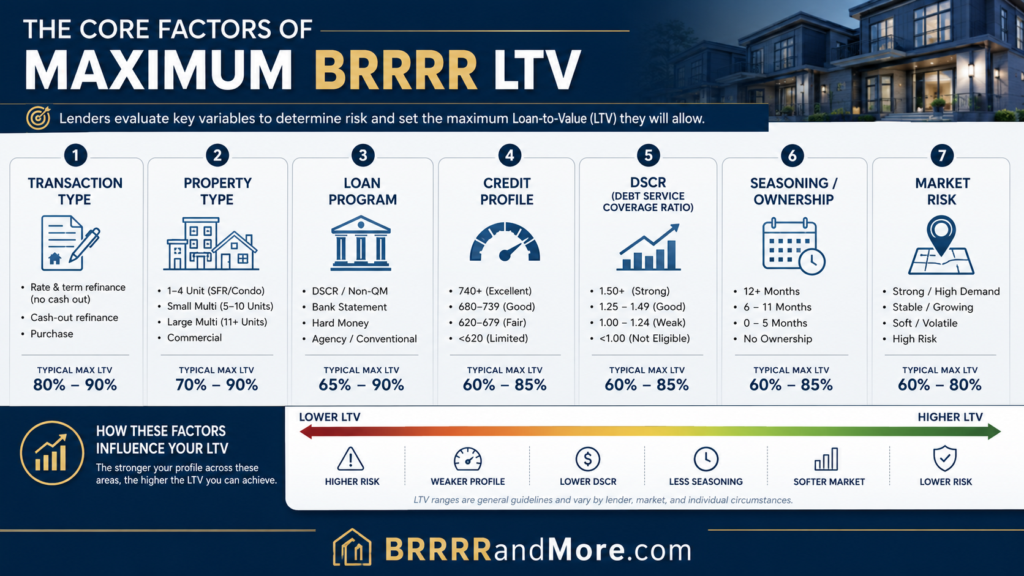
Maximum LTV may depend on:
Transaction Type
Purchase, limited cash-out refinance, and cash-out refinance transactions can have different limits.
Occupancy
Owner-occupied, second-home, and investment-property loans may receive different treatment.
Property Type
Limits may differ for:
- Single-family homes
- Two- to four-unit properties
- Condominiums
- Rural properties
- Mixed-use properties
- Short-term rentals
- Manufactured housing
Loan Product
Conventional, portfolio, DSCR, bridge, private, and commercial loans have different underwriting structures.
Borrower Qualifications
Credit, experience, income, liquidity, and reserves may affect available leverage.
Property Cash Flow
DSCR may reduce the permitted loan below the LTV limit.
Seasoning
Ownership duration, existing-loan age, and cost-basis rules can restrict proceeds.
Market and Property Risk
Lenders may reduce leverage in markets or property types they consider less liquid or more volatile.
Loan Size
Very small or very large loans may receive different terms or minimum equity requirements.
Is 70% LTV Good for a BRRRR Refinance?
A 70% LTV refinance is neither universally good nor bad.
It may provide a reasonable balance among:
- Capital recovery
- Equity
- Mortgage payment
- Cash flow
- Lender eligibility
- Downside protection
But the correct target depends on the project.
A 70% loan may be too high when:
- Rent is weak
- Taxes and insurance are high
- Repairs are likely
- Cash flow is thin
- The market is declining
- The loan has a short maturity
- The rate is high or variable
It may be unnecessarily low when:
- Rent strongly supports the debt
- The property has substantial value margin
- The investor needs liquidity
- Reserves remain adequate
- The permanent loan has stable terms
- The recovered capital has a productive use
The correct question is not:
What is the highest LTV the lender offers?
It is:
What LTV produces a sustainable rental while meeting my capital and risk objectives?
When a Lower LTV May Be Better
A lower LTV may be appropriate when you want:
- Stronger monthly cash flow
- More property equity
- Lower interest expense
- Better protection against declining values
- Greater tolerance for vacancy
- Easier future refinancing
- Lower balloon or maturity risk
- A less leveraged portfolio
A lower loan may also be necessary when rent does not support higher debt.
When a Higher LTV May Be Appropriate
A higher LTV may be appropriate when:
- The property has strong cash flow
- The appraisal is well supported
- The loan has stable long-term terms
- Reserves remain adequate
- You have another productive use for the capital
- The portfolio is not already overleveraged
- The refinance costs are reasonable
- You understand the reduced equity cushion
The added proceeds should improve your financial position rather than merely enable another thinly capitalized project.
Common BRRRR LTV Mistakes

Confusing LTV With LTC
LTV uses property value.
LTC uses project cost.
Confusing LTV With the 70 Percent Rule
The acquisition rule and lender ratio are different calculations.
Using ARV Before It Is Supported
An investor estimate does not guarantee the refinance appraisal.
Ignoring Cost-Basis Restrictions
The lender may use current value for appraisal purposes but still limit proceeds according to documented cost.
Assuming Maximum LTV Equals Approved Loan
DSCR, credit, reserves, loan limits, and other requirements may produce a smaller loan.
Ignoring Closing Costs
Gross loan proceeds are not the amount returned to you.
Ignoring Existing Liens
The first mortgage may understate total leverage.
Maximizing LTV Without Testing Cash Flow
A larger loan can reduce or eliminate monthly cash flow.
Evaluating Cash-on-Cash Return Alone
A high return percentage may result from very little capital remaining while the property carries substantial debt.
Assuming the Same LTV Will Be Available Later
Lender programs, property values, rates, and borrower qualifications may change.
Failing to Stress-Test the Appraisal
A modest value reduction can materially lower refinance proceeds.
Questions to Ask a Refinance Lender About LTV
Value
- What value will you use in the LTV calculation?
- Is it the current appraisal, purchase price, or documented cost?
- Is the value subject to seasoning?
- Do you require a full appraisal?
- Can the loan be limited by an appraisal review?
Maximum Leverage
- What is the maximum LTV?
- Does it differ for cash-out and rate-and-term refinances?
- Does it differ by property type or unit count?
- Does borrower experience affect it?
- Is there a lower maximum when the property was recently acquired?
Cash Flow
- Is the loan also limited by DSCR?
- How do you calculate qualifying rent?
- Which expenses are included?
- Do you use lease rent or market rent?
- What happens when DSCR supports less than the LTV limit?
Liens
- How do you calculate CLTV?
- Can subordinate debt remain?
- Must private or seller financing be repaid?
- How is a HELOC treated?
Proceeds
- Which costs are deducted from the loan?
- How much cash can be returned?
- Are reserves withheld?
- Is there a minimum cash contribution?
- Are documented rehab costs recoverable?
Timing
- When must seasoning be complete?
- Can the appraisal be ordered before seasoning?
- Can maximum LTV change before closing?
- How long is the appraisal valid?
- What happens if the loan program changes?
How to Select a Target LTV
Begin by calculating several alternatives.
For each LTV, determine:
- Gross loan amount
- Existing debt payoff
- Refinance costs
- Cash returned or required
- Capital remaining
- Monthly payment
- Cash flow
- Cash-on-cash return
- Gross equity
- DSCR
- Reserves after closing
Then test each scenario with:
- Lower appraisal
- Lower rent
- Higher interest rate
- Higher taxes and insurance
- Vacancy
- Major repair
- Smaller lender-approved loan
The target LTV should remain manageable under a reasonable downside case.
Use the BRRRR calculator to compare how different appraisal values and LTV assumptions affect refinance proceeds, debt, cash flow, and capital remaining.
Comparing several acquisition, rehab, and refinance structures? Rehab Valuator provides advanced BRRRR deal analysis, rehabilitation budgeting, financing comparisons, and investor and lender reporting when you need to model the project in greater detail.
BRRRR LTV Review Checklist
Before relying on an LTV assumption, confirm:
Acquisition Loan
- Purchase-price advance
- As-is LTV
- ARV LTV
- LTC
- Rehab funding
- Required cash contribution
Property Value
- As-is value
- ARV
- Completed appraisal
- Comparable-sale support
- Appraisal downside scenario
Refinance
- Maximum LTV
- Transaction type
- Seasoning
- Cost-basis limits
- Existing debt payoff
- Closing costs
- Cash returned
- Capital remaining
Operating Performance
- Market rent
- Lease rent
- Vacancy
- Management
- Maintenance
- Taxes
- Insurance
- Capital reserves
- Debt service
- DSCR
Risk
- Equity after closing
- Portfolio leverage
- Cash reserves
- Lower-value scenario
- Higher-rate scenario
- Lower-rent scenario
- Backup lender
- Alternative exit
Include these calculations within a complete BRRRR deal analysis rather than selecting the loan based solely on the largest proceeds.
Final Perspective
BRRRR LTV measures the relationship between the loan and the property’s value, but its effect reaches far beyond a single percentage.
LTV influences:
- How much a lender may provide
- How much cash you contribute
- How much capital you recover
- How much equity remains
- How large the mortgage payment becomes
- How much cash flow the property retains
- How sensitive the investment is to setbacks
A lower LTV can provide stronger equity and cash flow while leaving more of your capital invested.
A higher LTV can return more capital while increasing leverage and reducing the property’s operating margin.
Do not automatically select the highest available LTV.
Compare the permanent debt with the property’s rent, expenses, reserves, appraisal risk, and your broader portfolio.
The appropriate LTV is the one that allows the refinance to accomplish its purpose without weakening the rental property you worked to create.