1031 Exchange vs Cash-Out Refinance After a Strong BRRRR
A successful BRRRR can leave you with a stabilized rental, meaningful equity, and more than one good way to use it.
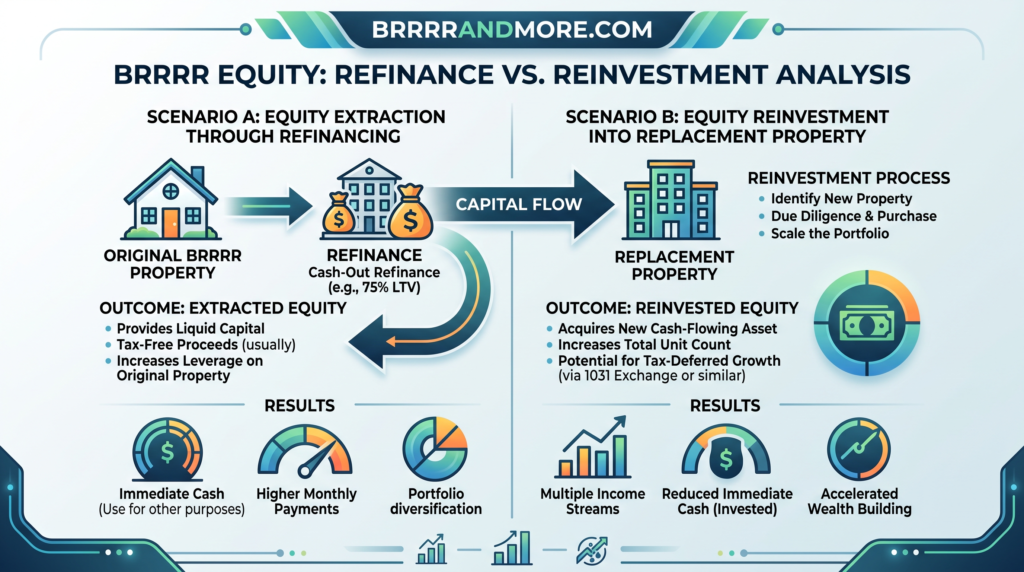
You can keep the property and pull out cash with another refinance. Another option is to sell, complete a 1031 exchange, and move the equity into a different investment.
The right answer depends on what the rental is still doing for you, what new financing would do to cash flow, and whether another property offers a better use of the equity. A 1031 exchange vs cash-out refinance decision is really a comparison between two ways of putting accumulated equity back to work.
Start With a Successful BRRRR Rental
Assume you own a rental with these numbers:
- Current property value: $500,000
- Existing mortgage balance: $250,000
- Monthly rent: $4,200
- Monthly operating expenses before debt service: $1,400
- Monthly NOI before debt service: $2,800
- Approximate equity before selling costs: $250,000
The rehab is finished, the property is rented, and the original BRRRR plan worked. You now control a $500,000 asset with about $250,000 of equity.
At this point, “repeat” does not automatically mean refinancing the same property again. Decide whether the current rental still deserves that equity or whether selling would let you redeploy it more effectively.
Keeping the Rental and Refinancing Again
Suppose a lender will refinance the property at 70% loan-to-value.
A $500,000 value at 70% LTV produces a new loan of about $350,000. After paying off the existing $250,000 mortgage, you have roughly $100,000 of gross cash-out proceeds before refinance costs.
Borrowed money generally is not included in gross income when you receive it because you have an obligation to repay it, according to the IRS treatment of loan proceeds. The tradeoff is that the extra cash comes with extra debt.
Watch What Happens to Cash Flow
Assume the existing $250,000 mortgage carries a 5.25% rate with a 30-year amortization for comparison. Principal and interest would be about $1,381 per month.
Now model the $350,000 replacement loan at a hypothetical 7.25% rate over 30 years. Principal and interest rises to about $2,388 per month.
With $2,800 of monthly NOI before debt service, the old loan leaves about $1,419 before income taxes and other owner-level items. The hypothetical new loan cuts that figure to roughly $412.
You gained access to close to $100,000 before refinance costs, but you also gave up around $1,000 per month of property-level cash flow in this simplified example.
Fannie Mae’s cash-out refinance guidance shows that these transactions are subject to loan-to-value, credit, eligibility, and pricing rules.
Selling and Exchanging the Equity
Now take the same $500,000 rental and sell it instead.
Assume selling and exchange expenses total $30,000 and the existing $250,000 mortgage is paid off at closing.
- Sale price: $500,000
- Less estimated selling and exchange expenses: $30,000
- Less mortgage payoff: $250,000
- Approximate equity available for exchange: $220,000
Instead of extracting roughly $100,000 and keeping the old rental, you may have about $220,000 available to put into a replacement property.
Suppose you identify a $650,000 rental and use the full $220,000 as equity. The remaining $430,000 is financed.
A qualifying 1031 exchange can defer recognition of gain when investment or business real estate is exchanged for qualifying like-kind real property under the applicable rules. Current IRS guidance on sales and exchanges explains how a properly executed like-kind exchange can postpone recognition of gain.
The exchange gives you access to more of the property’s accumulated equity than the refinance example, but you no longer own the original rental.
Compare What You Own After Each Choice
The 1031 exchange vs cash-out refinance choice becomes clearer when you look past the closing proceeds and compare the resulting portfolio.
Is the Current Rental Still a Strong Asset?
A low-cost loan, reliable tenants, favorable taxes, and manageable maintenance can make a mature BRRRR property difficult to replace.
If the rental still produces strong returns and requires little attention, keeping it may be the better move. The calculation changes when expenses are climbing, major capital work is approaching, or the property no longer fits your strategy.
What Does the Refinance Do to Monthly Cash Flow?
Do not judge a cash-out refinance by the check you receive at closing.
Run the new debt service against current NOI, then stress-test the property for vacancy, repairs, insurance increases, and a weaker rent year. If pulling $100,000 out reduces monthly cash flow from about $1,400 to $400, decide whether the next investment can reasonably justify that loss.
A refinance works best when the rental can comfortably carry the new debt and the released capital already has a clear job.
Can the Replacement Property Beat What You Sold?
Do not let a 1031 exchange push you into a larger property simply because you need somewhere to place the equity.
Compare the old rental with the proposed replacement on NOI, debt service, repairs, location, tenant profile, and management burden. Financing $430,000 at the same hypothetical 7.25% rate produces principal and interest of about $2,933 per month, so the replacement needs enough income to support that debt.
The new deal has to earn the equity.
When Keeping and Refinancing Looks Better
A cash-out refinance deserves a serious look when:
- The existing property still produces strong cash flow.
- Your current rental is stable and easy to manage.
- You need only part of the available equity.
- Near-term repair risk is limited.
- You already know how you will use the cash-out proceeds.
- Selling costs would consume too much capital.
This route also preserves the asset you already spent time acquiring, rehabbing, and stabilizing.
When Selling and Exchanging Has More Appeal
A 1031 exchange can be stronger when:
- Too much equity is sitting in a property with modest returns.
- The rental no longer fits your market or portfolio strategy.
- You want to move into a larger or higher-income asset.
- Refinancing would cut cash flow too sharply.
- Major repairs or management problems are approaching.
- A replacement property offers a better use for the equity.
Plan the exchange before the sale if you choose this route. Our 1031 exchange guide for real estate investors covers qualified intermediaries, identification rules, deadlines, and the broader process.
Run Both Deals as If You Were Buying Them Today
One useful test is to ignore your history with the current rental for a moment.
Ask whether you would buy it today at $500,000 with the financing you expect to carry after the refinance. Next, analyze the replacement property at its actual price and new debt.
That side-by-side comparison helps strip away the attachment that can come with a successful BRRRR.
If you want a structured way to compare income, expenses, financing, and return assumptions, the Investment Real Estate Analysis ebook uses a case-study approach to rental property analysis.
Put the Equity Where It Can Work Harder
The 1031 exchange vs cash-out refinance decision comes down to what you want your equity to do next.
A refinance lets you keep a proven rental while pulling out part of its value. The cost is higher debt and often lower monthly cash flow.
A 1031 exchange can move a larger share of accumulated equity into another property while deferring qualifying gain. In return, you give up the rental you already know and take on a new acquisition.
Run both paths with the same discipline you used when you bought the original BRRRR. Compare the cash you can access, the debt you will carry, the income you will keep or give up, and the quality of the asset you will own afterward.
The better choice is the one that gives your equity the stronger job.